
Your Request is under process, Please wait.

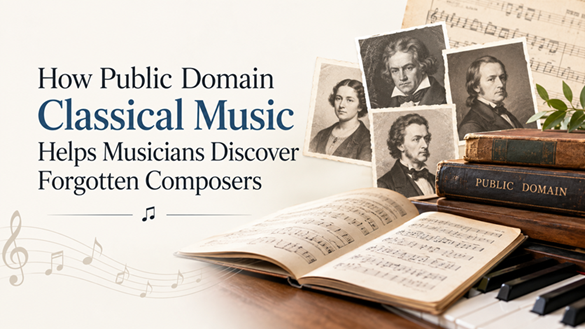
Every music history class covers the same six or seven names. Bach, Mozart, Beethoven, a few others, and that's usually where the syllabus stops. But classical music history is full of composers who wrote genuinely good work and just never made it into the standard curriculum, for reasons that had more to do with luck and timing than talent.
Every music history class covers the same six or seven names. Bach, Mozart, Beethoven, a few others, and that's usually where the syllabus stops. But classical music history is full of composers who wrote genuinely good work and just never made it into the standard curriculum, for reasons that had more to do with luck and timing than talent.
Public domain classical music is quietly responsible for a lot of these composers getting a second look, decades or centuries after everyone stopped paying attention to them.
Plenty of composers were well respected in their own lifetime and then just faded. Sometimes a rival composer's work got printed more widely and stuck around longer. Sometimes a war or a shift in musical fashion buried someone's catalog for a generation or two. None of that means the music itself was weak. It just means nobody kept championing it once the composer was gone.
This is where things get interesting for anyone actually looking. Once a piece enters the public domain, cost stops being the reason nobody plays it. If the music's been sitting unplayed, it's usually not because it's bad. It's because nobody handed it to the right musician at the right moment.
A piece by an obscure composer competing against a full edition of Chopin doesn't stand much chance if both cost the same amount of money. Musicians default to the safe, familiar choice almost every time. Take the price barrier away, though, and suddenly a curious player has no real reason not to try something unfamiliar.
That's a big part of why uncopyrighted music keeps surfacing names most people have genuinely never heard of. A cellist scrolling through free scores has nothing to lose by pulling up a piece from a composer they don't recognize. If it's good, they've found something new. If it's not, they've lost ten minutes, not twenty dollars.
This isn't just a piano phenomenon. Anyone hunting for viola solo sheet music, for instance, runs into a repertoire gap that free access does a lot to fill.
The viola never had the same volume of solo literature written for it as the violin, so a lot of what does exist comes from lesser-known composers who wrote specifically for the instrument. Without free access to those scores, a huge chunk of that repertoire would just stay invisible to most players.
Even familiar pieces play a role here. Someone comparing Für Elise notes across different free editions often stumbles onto other Beethoven works, or nearby contemporaries, just by browsing the same collection a little further than they planned to.
Finding these composers usually takes a bit more effort than typing a famous name into a search bar. A few habits help.
● Browse by era or region instead of by composer name you already recognize
● Look through anthologies and collections rather than single-piece downloads
● Check footnotes or editorial notes, since they sometimes mention contemporaries worth exploring
● Pay attention to teachers or performers who specialize in overlooked repertoire
Rediscovery doesn't happen from one lucky find. It happens when you make a habit of looking somewhere other than the usual list.
● Set aside time occasionally to browse a collection with no specific piece in mind
● Keep a running list of unfamiliar names worth revisiting later
● Compare a forgotten composer's work against something familiar from the same era
● Share what you find, since a lot of rediscovery spreads through word of mouth between musicians
Access alone doesn't guarantee anyone gets remembered, but it's the first requirement. A composer nobody can find won't get rediscovered no matter how good the music actually was, which is exactly why public domain classical music matters so much to this whole process.
Sheet Music International keeps a wide catalog available for exactly this kind of exploration, so the names worth finding don't stay buried just because nobody happened to look.
It removes the cost barrier that usually keeps musicians sticking to familiar names, making it easier to try something unfamiliar with nothing to lose.
Yes, though it helps to browse collections and anthologies rather than relying on a single random upload for accuracy.
The viola has a smaller solo repertoire overall, so free access plays a bigger role in surfacing lesser-known composers who wrote for the instrument.
Often, yes. Browsing collections for a familiar piece frequently surfaces contemporaries or related works nearby.
Browse by era or region instead of searching for names you already know, and pay attention to anthologies rather than single downloads.

Sep 13, 2026


.png)
Aug 05, 2026
Follow us : 


Sheet Music International - Copyright 2026 all rights reserved
| English: Sheet Music (PDF) | Free Scores | French: Sheet Music (PDF) | Free Scores | Greek: Sheet Music (PDF) | Free Scores |
| German: Sheet Music (PDF) | Free Scores | Spanish: Sheet Music (PDF) | Free Scores | Portuguese: Sheet Music (PDF) | Free Scores |
| Italian: Sheet Music (PDF) | Free Scores | Russian: Sheet Music (PDF) | Free Scores | Norwegian: Sheet Music (PDF) | Free Scores |
| Ukrainian: Sheet Music (PDF) | Free Scores | Polish: Sheet Music (PDF) | Free Scores | Dutch: Sheet Music (PDF) | Free Scores |

