
Your Request is under process, Please wait.

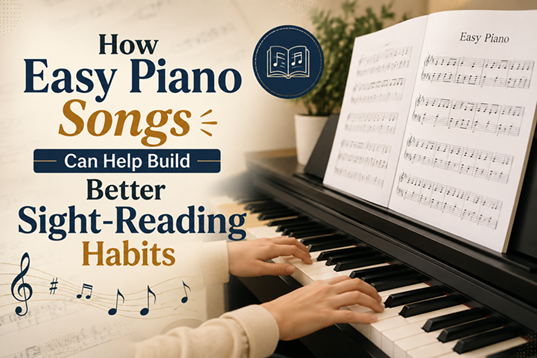
Most people practice the same three or four pieces until they can play them with their eyes closed, then wonder why sight-reading a brand new score still feels like starting from scratch. Sight-reading isn't a bonus skill you pick up as a side effect of getting good.
Most people practice the same three or four pieces until they can play them with their eyes closed, then wonder why sight-reading a brand new score still feels like starting from scratch. Sight-reading isn't a bonus skill you pick up as a side effect of getting good.
It's built the same way any habit is built: through repetition on material that doesn't demand your full attention just to survive it. That's exactly the role an easy piano song plays, and it's a role most players skip right past.
Repeating a small set of songs over and over tells your hands where they need to go before your eyes have even finished reading the measure. That’s fine for performance polish, but it’s the opposite of what sight-reading needs. Reading ahead, immediately seeing patterns, and responding to notes you’ve truly never seen before- none of that gets trained on a piece you already have committed to memory.
An easy piano song you haven't played yet forces your eyes to actually do the work. Because the technical demands are low, your brain has room left over to focus on the reading itself instead of just surviving the fingering.
Not every simple piece builds sight-reading equally well. A short, repetitive piece with barely any variation doesn't stretch your reading much after the first line, since you're basically reading the same pattern again and again. What works better is something with enough variety to keep your eyes moving forward, paired with a difficulty level low enough that your fingers aren't the bottleneck.
Public domain songs are a natural fit here, mostly because there's such a huge range of them available at every difficulty level. You're not stuck picking from a narrow catalog someone decided was "beginner friendly." You can pull from centuries of repertoire and just grab whatever feels genuinely unfamiliar.
The routine only holds if you treat it like a routine and not a one time experiment. There are a couple of things that separate sight-reading practice that really makes you better at sight-reading from sight-reading practice that falls apart after a week.
● Pick a new piece each session rather than reusing last week's discovery
● Set a firm rule against stopping to fix mistakes mid-phrase, since stopping defeats the entire point
● Track roughly how far you get through a piece before your reading starts to break down
● Permit yourself to play badly, since accuracy isn't actually the goal here
Pulling from a public domain music download each week keeps the material fresh without turning this into an expensive habit. There's no reason to buy new material constantly when the point is exposure to unfamiliar notation, not building a polished performance repertoire.
One-stop shopping for the whole habit makes this so much easier to maintain. Starting every week from square one to search is precisely the sort of friction that kills a routine before it has a chance to take hold.
● Keep a running list of composers or eras you haven't sampled yet
● Bookmark a reliable public domain music library instead of hunting through random search results each time
● Mix skill levels slightly, occasionally reaching a bit above your comfort zone
● Rotate between instruments if you play more than one, since the reading skill transfers
This kind of practice isn't unique to keyboard players. Chamber musicians constantly build the same reflex, especially in ensemble settings where two players are reading interlocking lines in real time.
Violinists working through something like bach concerto two violins, for instance, get exposed to exactly this kind of pressure, following an unfamiliar second part while staying locked to a partner's tempo. The underlying skill, reacting to notation you haven't rehearsed, is identical no matter which instrument you're holding.
Sight-reading gets better the same way any skill gets better, through consistent, low-stakes repetition rather than the occasional heroic effort. Sheet Music International keeps a wide range of pieces across difficulty levels for exactly this kind of ongoing practice.
Lower technical demands leave more attention for actually reading the notation, which is the skill sight-reading practice is meant to build.
Yes, mostly because of the sheer range available across skill levels and eras, so you're never stuck reusing the same limited catalog.
Weekly works well for most players, since the goal is exposure to unfamiliar notation rather than mastering any single piece.
Look for one with a wide range of composers and difficulty levels, so you can keep the material genuinely unfamiliar each session.
Yes. Reading an unfamiliar part while staying locked to another player builds the same reflex as solo sight-reading, just under added pressure.

.png)


Sep 13, 2026




Follow us : 


Sheet Music International - Copyright 2026 all rights reserved
| English: Sheet Music (PDF) | Free Scores | French: Sheet Music (PDF) | Free Scores | Greek: Sheet Music (PDF) | Free Scores |
| German: Sheet Music (PDF) | Free Scores | Spanish: Sheet Music (PDF) | Free Scores | Portuguese: Sheet Music (PDF) | Free Scores |
| Italian: Sheet Music (PDF) | Free Scores | Russian: Sheet Music (PDF) | Free Scores | Norwegian: Sheet Music (PDF) | Free Scores |
| Ukrainian: Sheet Music (PDF) | Free Scores | Polish: Sheet Music (PDF) | Free Scores | Dutch: Sheet Music (PDF) | Free Scores |

