
Your Request is under process, Please wait.

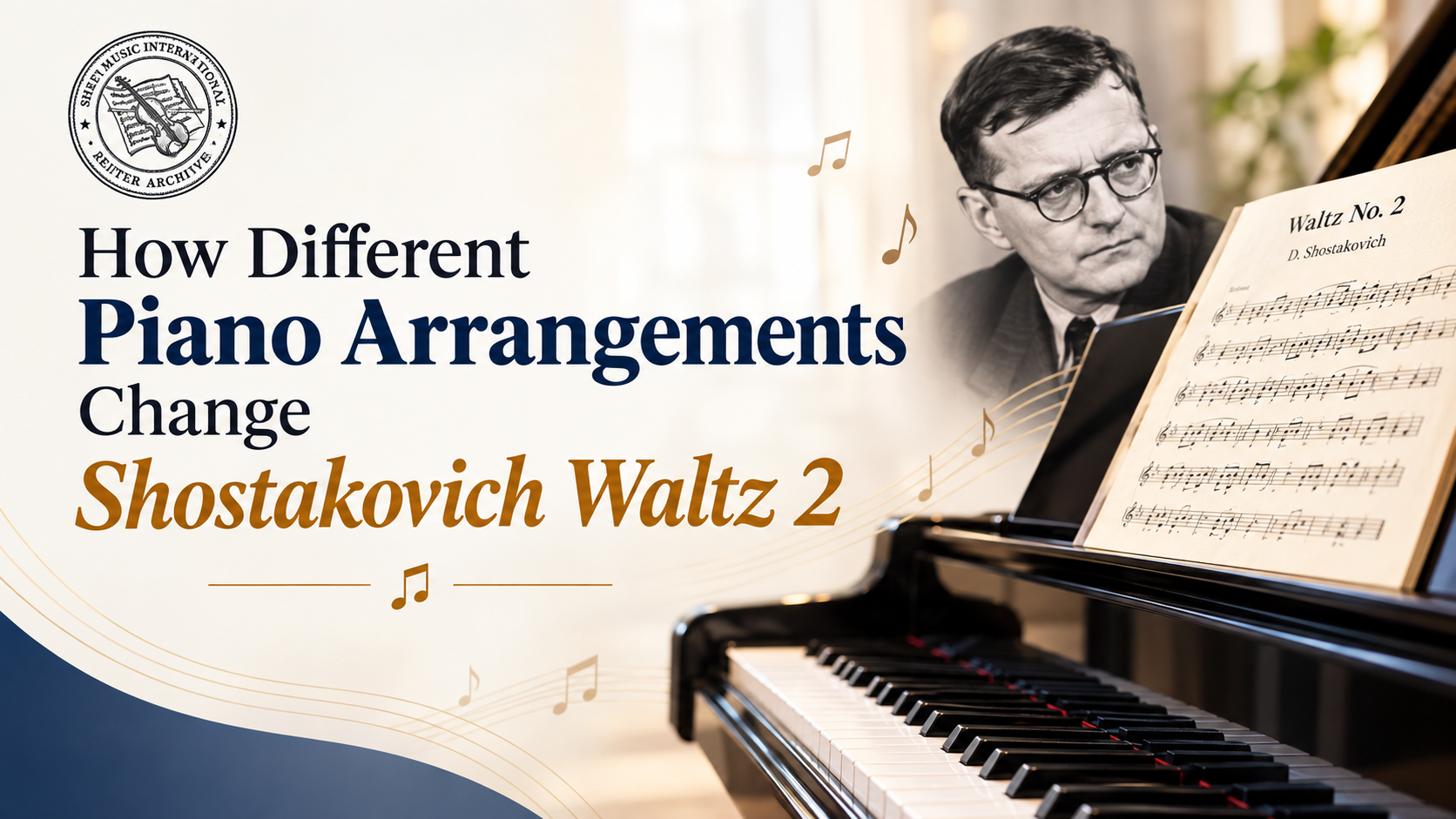
Pull up three different piano versions of this piece, and you'll swear you're looking at three different pieces of music. The melody survives everywhere, but almost nothing else does. That's the strange part about shostakovich waltz 2 piano sheet downloads specifically.
Pull up three different piano versions of this piece, and you'll swear you're looking at three different pieces of music. The melody survives everywhere, but almost nothing else does. That's the strange part about shostakovich waltz 2 piano sheet downloads specifically.
The piece was never written for solo piano to begin with, so all editions are someone's transcription of an orchestral score, and not a direct copy of an original piano manuscript.
Shostakovich Waltz 2 was originally a movement from a larger orchestral suite, in which individual instrumental lines darted in and out of each other.
To condense this into two hands means that the person has to be making judgment calls constantly. Which line becomes the melody. Which countermelodies get dropped entirely because there simply aren't enough fingers to cover them. What remains of the harmonic detail and what is compressed into something playable.
Different arrangers call for different things here. This is exactly why one piano version sounds a lot more full than another, even if they both claim to be the same piece.
If you put a few of the arrangements side by side, you will see that the top line, the tune most people actually recognize, hardly changes at all. Everything under it is constantly shifting. One of the arrangers keeps his left hand busy with countermelody. Another pares it down to simple chords to let the melody breathe. A third splits the texture up differently all round, and gives some of the accompaniment to the right hand where the orchestra never intended it to go.
This is where Piano Notes on the page can look deceptively similar at a glance, while actually representing very different musical decisions underneath.
Not every arrangement exists for the same purpose. A few are clearly meant for concert performance, keeping as much orchestral color as two hands can manage. Others are pared down specifically for students, prioritizing playability over fullness.
If you're working through Classical piano sheet music easy enough to actually be enjoyable rather than a technical wall, it helps to know which category you're looking at before you start practicing.
A performance-oriented arrangement might look impressive on paper but genuinely frustrate a newer player. A learning-focused one might feel a little thin to someone who already knows the orchestral original well.
What Actually Changes Between Versions
Once you know what to look for, spotting the differences takes minutes instead of a full practice session wasted on the wrong copy.
If you've already got a couple of options downloaded, this takes almost no time to sort through.
There's no single definitive piano version of this piece, and honestly there probably shouldn't be. An orchestral work translated for two hands is always going to involve compromise somewhere.
What matters is knowing which compromises a given Shostakovich Waltz 2 piano sheet made before you spend weeks learning it. Sheet Music International keeps a range of arrangements available so you can compare before settling on one.
Because the piece was originally orchestral, every piano version is an interpretation of which instrumental lines matter most.
Not really. Accuracy depends on what the arrangement is trying to do, whether it prioritizes performance color or playability for learning.
The melody line usually stays close to the original. What changes most is the left-hand texture and secondary countermelodies underneath it.
Yes, several arrangements simplify the accompaniment specifically for learning, though it's worth comparing a few before settling on one.
Play through the opening bars of a couple of versions and see which one feels manageable without losing the melody you actually recognize.


Sep 13, 2026


.png)
Aug 05, 2026
Follow us : 


Sheet Music International - Copyright 2026 all rights reserved
| English: Sheet Music (PDF) | Free Scores | French: Sheet Music (PDF) | Free Scores | Greek: Sheet Music (PDF) | Free Scores |
| German: Sheet Music (PDF) | Free Scores | Spanish: Sheet Music (PDF) | Free Scores | Portuguese: Sheet Music (PDF) | Free Scores |
| Italian: Sheet Music (PDF) | Free Scores | Russian: Sheet Music (PDF) | Free Scores | Norwegian: Sheet Music (PDF) | Free Scores |
| Ukrainian: Sheet Music (PDF) | Free Scores | Polish: Sheet Music (PDF) | Free Scores | Dutch: Sheet Music (PDF) | Free Scores |

