
Your Request is under process, Please wait.

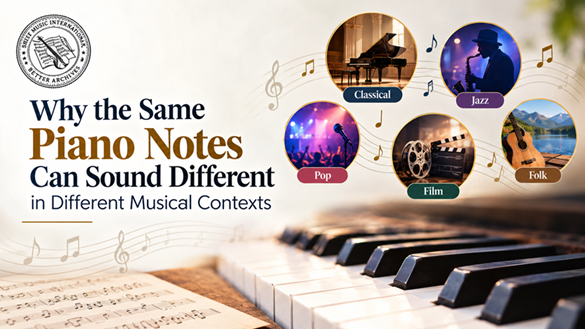
Now play that same C at the start of a quiet, held-breath opening. Play it again as the last, triumphant hammer-blow of a big finish. Your ear will swear it just heard two different notes. It didn't. The pitch never budged.
Play a C by itself. It's nothing. Just a sound sitting in the air.
Now play that same C at the start of a quiet, held-breath opening. Play it again as the last, triumphant hammer-blow of a big finish. Your ear will swear it just heard two different notes. It didn't. The pitch never budged.
What changed was everything wrapped around it, and that's the whole trick behind why the moonlight sonata piano notes in that famous opening land so differently than the same pitches would almost anywhere else.
Here's the part nobody tells you early on: a single note, on its own, carries barely any feeling. Tempo does the heavy lifting. So does volume. So does whatever chord sits underneath it, and so, weirdly enough, does the silence right before it lands.
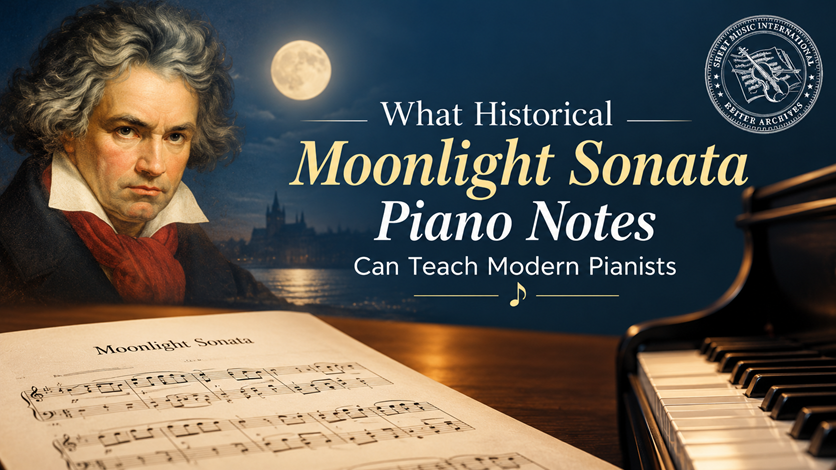
Beethoven's opening triplets prove this better than almost anything in the repertoire. Speed them up, and they turn jittery, almost anxious. Slow them down, play them soft, and those same moonlight sonata piano notes turn into something closer to a held breath than a melody. Nothing on the page moved. Everything about playing it did.
I've watched teachers try explaining this for years, and it rarely lands the first time. Fair enough. This is one of those things you have to feel under your own hands before it means anything.
Grab any Classical piano sheet music easy enough for a true beginner, and here's what most people miss: simplifying a piece doesn't just mean fewer notes. It changes how the notes that survive actually feel. Pull one supporting inner voice out of a chord, and a melody that used to sound lush can suddenly feel thin and exposed. Same melody. Completely different coat of paint holding it up.
Not the arrangement failing. It's proof that "the melody" was never really the melody alone; it was the melody plus everything propping it up. A kid working through a simplified version isn't playing a lesser copy. They're playing a version where the same notes are quietly doing a different job.
What actually bends a note's emotional color, without touching the note itself:
Where this gets genuinely strange is in pieces the composer never finished. Pull up Schubert Unfinished Symphony sheet music sometime, and you'll see what I mean.
The material just stops. Whatever motifs Schubert set in motion are left hanging mid-air with nowhere to go, because he never wrote them a resolution. Anyone arranging it for piano afterward had to decide what context to build around ideas that were never built to end that way.
Strange seat for an arranger. Half freedom, half burden. The actual notes Schubert left behind are fixed, untouchable. But the thing that would normally give them their final shape, the resolution, the landing, simply doesn't exist. Pull up two or three arrangements, and you'll hear how differently people handled that gap.
You don't need perfect pitch or a theory degree to notice any of this. A few ways to hear it for yourself:
Once this clicks, it changes how you sit down to practice. A score stops being a fixed sequence of pitches and starts looking like a web of relationships, where the moonlight sonata piano notes, or any notes at all, borrow their meaning from whatever is happening around them.
Sheet Music International keeps a wide range of editions and arrangements side by side, which makes this kind of comparison easier to hear instead of just read about.
A note's emotional weight comes mostly from what surrounds it, not the pitch itself. Shift the tempo or dynamics and the same pitch lands somewhere completely different emotionally.
Yes, more than most people expect. Stripping texture out of Classical piano sheet music easy enough for a beginner can leave a melody feeling exposed, even though the core notes never moved.
Because the piece never got a resolution, arrangers had to invent context around motifs that were never meant to end there, which makes context nearly impossible to miss.
Yes. Dynamics, harmony, tempo, and the silence around a note all shift how it's experienced, separate from the actual pitch.
Not even close. Beginners pick up on it too, even without being able to explain why, which is exactly why comparing a simplified and full version of the same piece is worth doing early.

.png)


Sep 13, 2026



Follow us : 


Sheet Music International - Copyright 2026 all rights reserved
| English: Sheet Music (PDF) | Free Scores | French: Sheet Music (PDF) | Free Scores | Greek: Sheet Music (PDF) | Free Scores |
| German: Sheet Music (PDF) | Free Scores | Spanish: Sheet Music (PDF) | Free Scores | Portuguese: Sheet Music (PDF) | Free Scores |
| Italian: Sheet Music (PDF) | Free Scores | Russian: Sheet Music (PDF) | Free Scores | Norwegian: Sheet Music (PDF) | Free Scores |
| Ukrainian: Sheet Music (PDF) | Free Scores | Polish: Sheet Music (PDF) | Free Scores | Dutch: Sheet Music (PDF) | Free Scores |

