
Your Request is under process, Please wait.

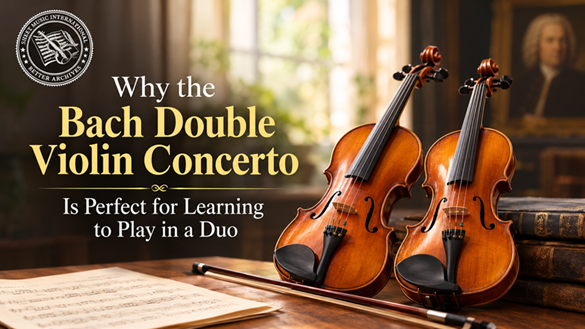
You and a friend both play violin. You’ve each spent months practicing alone, and you’re ready for something more fun than scales. So you pull up a piece you can play together, set up two stands, and realize you have no idea how to actually play with another person. That’s where the Bach Double Violin Concerto comes in.
You and a friend both play violin. You’ve each spent months practicing alone, and you’re ready for something more fun than scales. So you pull up a piece you can play together, set up two stands, and realize you have no idea how to actually play with another person. That’s where the Bach Double Violin Concerto comes in.
Bach wrote his Concerto for Two Violins in D minor around the 1720s, and it’s still one of the most loved duets in the repertoire. What makes it special is how evenly the work is shared. Neither player is stuck with accompaniment. Both violins get the melody, both get the supporting lines, and they trade roles constantly.
That balance is exactly what a student duo needs. You’re never just following, and you’re never just leading.
Playing alone, you only have to worry about yourself. Playing a duet, you suddenly have to hear two parts at once. In the opening movement, one violin states a musical idea and the other answers it a moment later, like a conversation where each person finishes the other’s thought.
To make that work, you have to pay attention while you play. You notice when your partner is rushing. You hear when your pitch drifts away from theirs. These small adjustments are the heart of ensemble playing, and Bach gives you a lot of chances to practice them.
The concerto has three movements, and each one teaches something different.
The first is lively and driven by imitation. Your parts chase each other, so rhythm and entrances have to be precise. If one of you comes in late, everybody hears it.
The slow middle movement is the emotional center of the piece. The two violins weave long, singing lines around each other, and the challenge shifts from speed to tone. You have to match your phrasing and decide together where the music breathes.
The finale brings the energy back up. It’s a good test of everything you’ve practiced, since staying together at a quick tempo is harder than it looks.
A few habits make the learning curve much gentler. Start slowly, well below the marked tempo, and play with a metronome until you’re together. Practice each part separately before combining them. Record yourselves and listen back, because you’ll catch balance problems you can’t hear while playing.
Most importantly, talk to each other. Decide where phrases begin, who sets the tempo, and how you’ll signal a change. Duo playing is as much communication as it is technique.
You don’t need two violins to enjoy this concerto. Arrangements exist for a violin and cello pairing, so mixed duos can play it too. If you’re a cellist, this is a great way to get cello sheet music into your practice that actually teaches you how to play with a partner.
It’s also worth thinking bigger than one piece. A cello repertoire list that mixes duets and chamber works with solo pieces will make you a more adaptable player. Bach’s solo cello suites make a natural anchor for that list, and the listening skills you build in a duet carry straight into them.
Here’s the good news. Bach died in 1750, so his compositions are firmly in the realm of free public domain music. That means classical sheet music public domain collections include his concertos, and you can download, print, and perform them without paying royalties.
One caution. The composition is public domain, but individual editions can still carry their own copyright if an editor added fingerings, bowings, or other markings. Look for clearly labeled public domain editions with clean, readable notation, and preview the first page before you print. A sharp scan saves you a lot of squinting at the stand.
Plenty of duets exist, but few teach as much as this one. You build intonation, timing, and listening skills at the same time, and you do it with music that sounds wonderful even when you’re still learning it. That combination is rare, and it’s why teachers have been assigning this concerto for generations.
Ready to play together? Browse the free sheet music library at Sheet Music International and download classical scores for violin, cello, and more, so you and your duo partner can start playing today.
It’s challenging, especially the outer movements, but intermediate players can manage it with slow, steady practice.
Not necessarily. Arrangements exist for other instrument pairings, including violin and cello.
Yes. Bach’s compositions are in the public domain, though specific printed editions may carry their own copyright.
Many duos start with the slow middle movement, since it focuses on tone and phrasing before speed.
Look for sites with clear scans, labeled editions, and difficulty ratings before you download.

.png)

Sep 13, 2026
Follow us : 


Sheet Music International - Copyright 2026 all rights reserved
| English: Sheet Music (PDF) | Free Scores | French: Sheet Music (PDF) | Free Scores | Greek: Sheet Music (PDF) | Free Scores |
| German: Sheet Music (PDF) | Free Scores | Spanish: Sheet Music (PDF) | Free Scores | Portuguese: Sheet Music (PDF) | Free Scores |
| Italian: Sheet Music (PDF) | Free Scores | Russian: Sheet Music (PDF) | Free Scores | Norwegian: Sheet Music (PDF) | Free Scores |
| Ukrainian: Sheet Music (PDF) | Free Scores | Polish: Sheet Music (PDF) | Free Scores | Dutch: Sheet Music (PDF) | Free Scores |

