
Your Request is under process, Please wait.

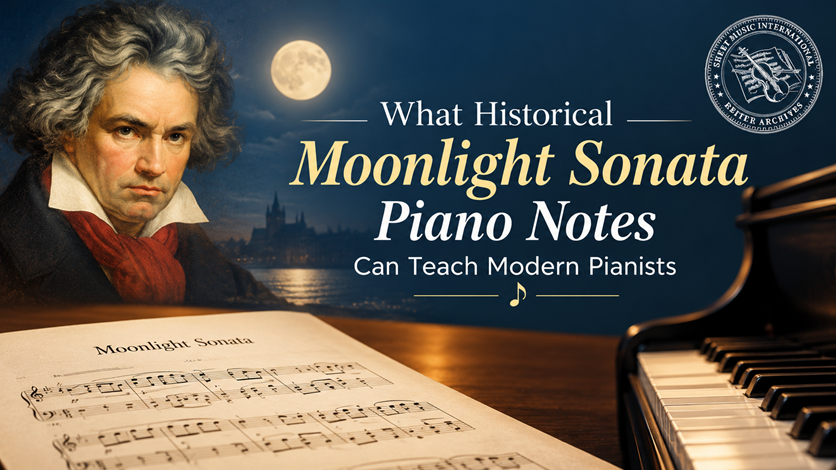
Dig up an old printed score, and you're not really looking at music. You are looking at decisions someone made decades ago that no one ever called decisions. The Moonlight Sonata piano notes on a century-old page come with a bunch of assumptions baked in: what the editor assumed about tempo, what they thought a home pianist could handle, what was kept and what disappeared quietly away because nobody thought it would matter later.
Dig up an old printed score, and you're not really looking at music. You are looking at decisions someone made decades ago that no one ever called decisions. The Moonlight Sonata piano notes on a century-old page come with a bunch of assumptions baked in: what the editor assumed about tempo, what they thought a home pianist could handle, what was kept and what disappeared quietly away because nobody thought it would matter later.
This is no footnote to historians. It changes how the piece feels under your fingers right now.
A score printed a hundred years back was never trying to be neutral. It reflects whatever that editor believed the piece needed, filtered through whatever playing habits were normal in their own time. Put an old copy next to a modern printing and the gap isn't small.
In some editions the pedal markings are heavier, in others almost absent. Copies shaped by Romantic taste swing wide and dramatic in dynamics, then pull back hard once later scholars tried walking that back toward the original.
None of that makes the old copies wrong. It just means each edition is really a snapshot: a record of what one person believed, at one moment, right before it went to print.
This pattern isn't unique to one famous sonata. Go hunting for Schubert Unfinished Symphony sheet music, and you’ll come across an even weirder version of the issue: a piece the composer never actually finished, arranged for piano by people who had no choice but to come up with their own answers about structure and pacing that Schubert never left behind. Each arranger filled that gap in their own way, so comparing a handful of editions tells you just as much about how editors think as it does about the music.
Dvorak Unfinished Sheet Music runs into the exact same wall. Arrangers had to work out how to present something left incomplete without pretending they'd finished the job for him. Sit with a case like that for a while, and something as heavily studied as Beethoven's sonata starts revealing fingerprints you'd have walked right past before.
It's tempting to glance at an old edition once, call it a curiosity, and move on. That sells the whole thing short. Here's what actually comes out of it:
You don't need special access or a musicology degree to do this yourself. A few honest steps get you most of the way there:
Treat old scores as something worth using, not a museum piece behind glass, and it changes your whole relationship with everything you practice from here on.
Every piece drags history behind it, whether that's Moonlight Sonata piano notes shaped by a century of shifting taste, or an unfinished symphony someone else had to finish arranging using their own best guess. Sheet Music International keeps historical and modern editions side by side, so that history is something you can dig into rather than just read about.
Editors from different eras added or stripped interpretive detail depending on the playing conventions of their own time, not purely on what Beethoven himself wrote.
It helps in a real way. Watching how pedaling and dynamics shifted over the decades changes how you read whatever edition you're currently working from.
Because arrangers had to make independent calls filling gaps the composer never resolved, which makes their editorial decisions far more visible than in a piece that was actually finished.
Yes, honestly a pretty clean one. Arrangers again had to decide how to present something left unfinished, which makes comparing a few versions genuinely useful for spotting editorial choices in action.
Not at all. Laying a few printed pages side by side and playing the same passage from each is something any practicing pianist can do without any special background.

.png)



Sep 13, 2026


Follow us : 


Sheet Music International - Copyright 2026 all rights reserved
| English: Sheet Music (PDF) | Free Scores | French: Sheet Music (PDF) | Free Scores | Greek: Sheet Music (PDF) | Free Scores |
| German: Sheet Music (PDF) | Free Scores | Spanish: Sheet Music (PDF) | Free Scores | Portuguese: Sheet Music (PDF) | Free Scores |
| Italian: Sheet Music (PDF) | Free Scores | Russian: Sheet Music (PDF) | Free Scores | Norwegian: Sheet Music (PDF) | Free Scores |
| Ukrainian: Sheet Music (PDF) | Free Scores | Polish: Sheet Music (PDF) | Free Scores | Dutch: Sheet Music (PDF) | Free Scores |

