
Your Request is under process, Please wait.

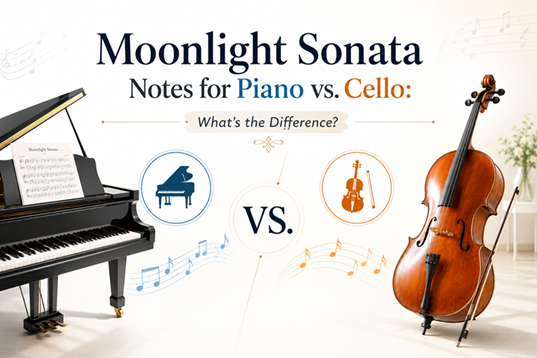
You’ve probably heard the opening bars of Beethoven’s Moonlight Sonata a hundred times without knowing the name. It’s in the movies, ringtones, and that one YouTube video where someone plays it in the dark with candlelight. But once you start to actually learn it, a question comes up fast. Should you be looking at piano notes or cello notes? And does it even matter where you begin?
You’ve probably heard the opening bars of Beethoven’s Moonlight Sonata a hundred times without knowing the name. It’s in the movies, ringtones, and that one YouTube video where someone plays it in the dark with candlelight. But once you start to actually learn it, a question comes up fast. Should you be looking at piano notes or cello notes? And does it even matter where you begin?'
It matters a lot. The two versions share the same melody but differ in the way they are played.
Beethoven wrote the Moonlight Sonata for solo piano in 1801, and that is still the original, the one that most people mean when they look for Moonlight Sonata notes. The piano version relies on the independence of both hands. Your left hand holds down those famous rolling triplets while your right hand carries the melody on top. It's one instrument doing the job of an entire ensemble.
Cello arrangements are transcriptions. That is, someone at some point adapted the piece for a single melodic line with piano or string accompaniment. Typically, the cellist will play the melody, and a second instrument will provide the harmony that the piano would normally provide alone. So right away, cello sheet music demands a whole different kind of coordination. You’re not doing two different things with two hands. You are working on tone, bow control, and phrasing on a single line.
The first movement of the Moonlight Sonata piano notes looks deceptively easy at first glance: common time, a steady triplet pattern running through almost the whole piece, three notes to a beat, repeated over and over. That simplicity is a trap. The moment your hands actually try it, the real difficulty shows up, and it has nothing to do with hitting the right notes.
It's about control. Those triplets can't just be played correctly, they have to disappear into the background, soft and even, so the melody can float above them without getting buried. Miss that balance and the whole piece sounds mechanical instead of dreamy. Nail it, and you start to hear why this piece has stuck around for two hundred years.
Then there's the pedal work. The famous opening in C-sharp minor asks pianists to use the sustain pedal with a light touch, just enough to let the notes bleed into each other and create that hazy, late-night sound Beethoven was chasing. Push down too hard and it turns into mush. Ease off too much and the atmosphere disappears completely. Finding that middle ground is really what separates a technically correct performance from one that actually sounds like moonlight.
Cello sheet music for the Moonlight Sonata notes usually transposes the melody to sit comfortably in the instrument's range, often in the same key or shifted slightly to suit open strings and bow technique. Instead of triplets under your fingers, you're managing bow speed and pressure to get that same smooth, sustained quality the piano achieves with pedaling.
There's also more room for expressive vibrato, something a piano simply can't do. A cellist can shape a single note, swell into it, taper it off. That's a different kind of emotional control than a pianist has, even though the melody underneath is recognizably the same tune.
Whichever instrument you're on, starting with easy Moonlight Sonata sheet music makes sense before tackling the full original score. Simplified arrangements strip back some of the technical demands, slower tempos, fewer hand crossings on piano, and less rapid bow work on cello, so you can learn the shape of the piece first and build up from there.
A lot of beginner arrangements also break the first movement into smaller sections, letting you master four or eight measures at a time instead of staring down the whole piece at once. That's genuinely a better way to learn it, even if you eventually want the full unedited version.
Honestly, it depends on what instrument is in front of you, but if you play both, the piano gives you the complete Beethoven experience since it's the original. Cello offers something the piano can't, a warmer, more vocal quality to that melody. Neither is more "correct." They're just different windows into the same piece.
If you're ready to start practicing, we've got free downloadable notes for both piano and cello arrangements, including beginner-friendly versions if you're just getting started. Head over to our sheet music International library and grab your copy today.
The first movement is beginner-friendly if you take it slow. The second and third movements get much harder, especially on the piano.
C-sharp minor is one of Beethoven's favorite keys for moody, atmospheric pieces.
Yes, especially with a simplified arrangement. The melody is manageable even for newer players since the harmony is handled by a second part.
You don't have to, but reading the notes helps you nail the timing and dynamics Beethoven actually wrote, not just the melody you remember hearing.
You can get Moonlight Sonata notes on sheet music International. They’ve got free downloads for piano and cello, including easy arrangements for beginners.



.png)
Aug 05, 2026




Follow us : 


Sheet Music International - Copyright 2026 all rights reserved
| English: Sheet Music (PDF) | Free Scores | French: Sheet Music (PDF) | Free Scores | Greek: Sheet Music (PDF) | Free Scores |
| German: Sheet Music (PDF) | Free Scores | Spanish: Sheet Music (PDF) | Free Scores | Portuguese: Sheet Music (PDF) | Free Scores |
| Italian: Sheet Music (PDF) | Free Scores | Russian: Sheet Music (PDF) | Free Scores | Norwegian: Sheet Music (PDF) | Free Scores |
| Ukrainian: Sheet Music (PDF) | Free Scores | Polish: Sheet Music (PDF) | Free Scores | Dutch: Sheet Music (PDF) | Free Scores |

