
Your Request is under process, Please wait.

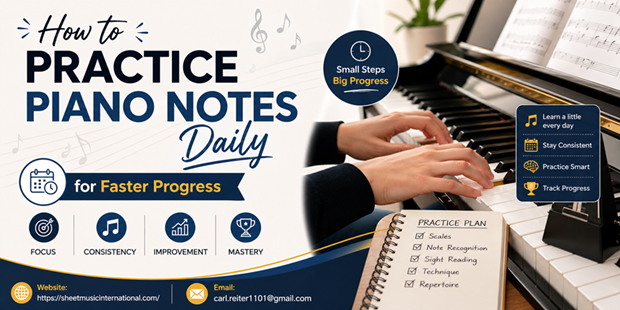
Picture this: you sit down at your piano after a long day, press a few keys, and for a moment, the noise of everything else fades away. Your fingers hesitate at first, searching for the right piano notes, but slowly, something clicks. The melody begins to take shape, not perfect, but real. You remember how confusing those notes once felt, and yet here you are, making progress one small step at a time.
Picture this: you sit down at your piano after a long day, press a few keys, and for a moment, the noise of everything else fades away. Your fingers hesitate at first, searching for the right piano notes, but slowly, something clicks. The melody begins to take shape, not perfect, but real. You remember how confusing those notes once felt, and yet here you are, making progress one small step at a time.
Some days feel frustrating, others surprisingly smooth, but each session adds a little more confidence. It’s not about playing flawlessly; it’s about showing up, learning, and enjoying the process. And with the right daily practice approach, those scattered notes can turn into music you are truly proud of.
At Sheet Music International, you will find a rich collection of sheet music designed to support your musical journey. Whether you are exploring timeless works or simple learning material, it’s a place where consistent practice meets the right guidance.
Building a strong connection with piano notes doesn’t happen through occasional effort; it grows through steady, intentional practice. Each time you sit at the piano, your brain strengthens its ability to recognize patterns, while your fingers become more responsive and controlled. Daily practice creates a rhythm of learning that helps you retain information longer and apply it more naturally.
Instead of relearning the same concepts, you begin to build on them, making each session more productive than the last. Over time, even complex passages start to feel manageable because your foundation is solid. Regular practice also sharpens your listening skills, allowing you to notice subtle differences in tone and timing. Most importantly, it transforms learning from a challenge into a habit, making progress feel both achievable and rewarding.
Have you ever felt stuck even after practicing piano regularly without seeing much improvement? The way you approach piano notes can make a huge difference in how fast you progress. Many learners spend time playing, but not always in a structured or focused way, which slows down their growth. With small changes in how you practice, you can turn even short sessions into meaningful progress. The goal is not just to play more, but to practice with intention and clarity.
Improving at the piano is less about talent and more about consistency and smart habits. When you understand how to work with notes effectively, everything from reading Beethoven's piano sheet music to playing songs becomes easier. Instead of repeating the same routine every day, introducing simple techniques can help you learn faster and stay motivated. Once your practice becomes more focused, you will notice smoother transitions and growing confidence in your playing.
Before jumping into songs, spend a few minutes reviewing piano notes on the staff. Focus on both treble and bass clefs, as understanding both is essential for balanced playing.
You can use flashcards, charts, or simple quizzes to test yourself. This step strengthens your ability to instantly connect written notes with keys on the piano, which is crucial for smooth playing.
Scales are one of the best ways to internalize piano notes. Start with basic scales like C Major, G Major, and A Minor. These help you understand the structure of music while improving finger strength and flexibility.
Playing scales daily also prepares you for more advanced pieces, including classical compositions like Beethoven's piano sheet music, which often require strong technical control.
One of the best ways to apply your knowledge is by playing real music. Fortunately, there’s a vast collection of free public domain music available online. These pieces are not only free but also perfect for learners at all levels.
Practicing with public domain music allows you to:
● Explore classical compositions
● Improve your reading skills
● Play structured and meaningful pieces
You can find a wide range of beginner-friendly and advanced sheet music on IMSLP and Sheet Music International. This makes it easy to build a diverse practice routine without spending money.
Instead of trying to play an entire piece perfectly, focus on small sections. Identify difficult measures and practice them slowly until you gain confidence.
This method helps you:
● Avoid frustration
● Improve accuracy
● Learn faster
Gradually increase your speed once you’re comfortable. This approach is especially useful when working with detailed free sheet music, where precision is essential.
Expanding your musical perspective can greatly improve your piano skills. Studying sheet music for cello may seem unrelated, but it actually helps you become a better musician.
Here’s how:
● It strengthens your bass clef reading
● It improves your understanding of harmony
● It trains your ear for deeper tones
By exploring cello sheet music, you gain a broader understanding of how piano notes fit into overall musical arrangements.
Improving your piano notes comes down to daily, focused practice and using the right learning resources. When you stay consistent, even short practice sessions help you build confidence, speed, and accuracy over time. Explore Beethoven's piano sheet music to broaden your musical understanding and keep your practice engaging. At Sheet Music International, you can easily access a wide range of sheet music to support your learning journey. Start today with simple steps and let your progress grow naturally with each session.

Sep 13, 2026




.png)
Aug 05, 2026

Follow us : 


Sheet Music International - Copyright 2026 all rights reserved
| English: Sheet Music (PDF) | Free Scores | French: Sheet Music (PDF) | Free Scores | Greek: Sheet Music (PDF) | Free Scores |
| German: Sheet Music (PDF) | Free Scores | Spanish: Sheet Music (PDF) | Free Scores | Portuguese: Sheet Music (PDF) | Free Scores |
| Italian: Sheet Music (PDF) | Free Scores | Russian: Sheet Music (PDF) | Free Scores | Norwegian: Sheet Music (PDF) | Free Scores |
| Ukrainian: Sheet Music (PDF) | Free Scores | Polish: Sheet Music (PDF) | Free Scores | Dutch: Sheet Music (PDF) | Free Scores |

