
Your Request is under process, Please wait.

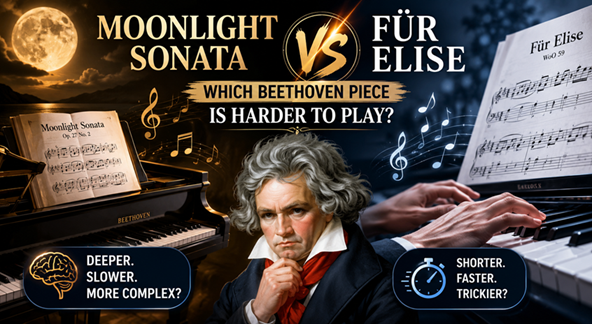
Ask any piano student to name a Beethoven piece, and nine times out of ten you'll hear the same two answers — Moonlight Sonata and Für Elise. These aren't just famous compositions. They're practically the entry point into classical piano for an entire generation of learners.
Most people assume Für Elise is the easy one. It shows up in beginner lesson plans, it feels approachable, and Moonlight Sonata sounds like something reserved for a recital stage. But that assumption doesn't hold up once you actually work through both pieces properly. The real answer depends on what sections you're playing, your technical level, and how much patience you have for the control these pieces demand.
Before comparing difficulty, you need to understand what you're actually comparing.
Für Elise is a self-contained piano piece with a central melody alternating with contrasting sections. Most students learn the opening theme and stop there — which is fine, but the full piece is a different experience.
Moonlight Sonata is a complete three-movement sonata. That slow, atmospheric opening everyone recognises is just the beginning. The second and third movements take the piece somewhere else entirely, both in mood and technical demand.
Just this distinction changes how you look at a few Piano Notes on the page. Their structure alone makes the comparison more nuanced than it first appears.
One reason Fur Elise Sheet Music remains a popular teaching choice is the accessibility of its opening section. For developing pianists, it offers several advantages:
● A slow and recognisable melody
● Manageable hand coordination
● Moderate tempo requirements
● Repetitive patterns that are easier to memorise
That familiar opening gives students something to hold onto — you're learning something you've already heard, something that sounds like music almost immediately. But stay with the piece long enough, and the middle sections start asking harder questions. Wider jumps, faster passages, hands that stop cooperating so easily. Students who only learned the opening theme often don't realise how much more the full piece demands.
The first movement of the Moonlight Sonata is often underestimated. Its calm character and measured tempo can create the impression of simplicity, even though it requires considerable control and musical maturity.
Its true challenge lies in the level of control required, a skill that often takes years to develop. Pianists must maintain:
● Consistent rhythm
● Smooth phrasing
● Balanced dynamics
● Emotional expression throughout the piece
Every note carries weight. The phrasing has to breathe. Experienced pianists spend years returning to this movement and finding new layers — that alone tells you something.
Then the third movement arrives and completely rewrites the rules. Fast, relentless, technically demanding in ways the first movement never hints. Rapid runs, powerful chords, continuous forward drive. Most casual listeners don't even know it exists.
A comparison of the opening themes tells only part of the story. The full compositions present very different levels of difficulty and artistic complexity.
Für Elise requires:
● Finger agility
● Basic hand independence
● Moderate speed control
● Accurate phrasing
Moonlight Sonata requires:
● Advanced dynamic control
● Greater endurance
● Stronger hand coordination
● Sophisticated musical interpretation
● High-level technique in the third movement
Für Elise has a ceiling. Moonlight Sonata keeps raising it.
Learning the notes is one thing. Making music out of them is something entirely different — and Beethoven demands the latter.
The first movement of the Moonlight Sonata is one of the clearest examples of this. You have to create an atmosphere, sustain tension across long, slow phrases, and make every note feel intentional. Nothing can be thrown away. That's why this piece keeps pulling musicians back across entire careers.
Many piano instructors view these pieces as complementary rather than competing, as each helps students develop a distinct set of musical and technical skills.
Für Elise helps students develop:
● Finger control
● Musical memory
● Basic expressive playing
Moonlight Sonata helps students strengthen:
● Advanced expression
● Pedaling techniques
● Dynamic control
● Long-form musical thinking
Work through both seriously, and you carry those skills across a wide range of repertoire. Musicians who later explore a Cello Repertoire List or chamber music often find that expressive instincts shaped by Beethoven translate remarkably well across instruments and styles.
The opening theme of Für Elise is often more approachable for developing pianists. Yet a comparison of the complete compositions reveals that Moonlight Sonata requires a higher level of technique, endurance, and musical maturity. The technical demands are higher, the emotional requirements are deeper, and the third movement alone puts it in a different category.
From the familiar melodies of Für Elise to the deeper challenges of Moonlight Sonata, Beethoven's music continues to inspire pianists of every level. Explore Sheet Music International for sheet music, educational resources, and a broader appreciation of these timeless masterpieces.
Yes, the complete Moonlight Sonata is generally considered more difficult due to its advanced technique and musical demands.
Parts of the first movement are manageable, but the full sonata requires intermediate to advanced skills.
Its memorable melody, approachable opening, and educational value make it a natural early choice.
The third movement — fast tempo, complex passages, and relentless technical intensity.
Yes. It builds finger control, phrasing, and expression that directly support Moonlight Sonata study.
Not really. Beyond the Piano Notes, dynamics, phrasing, timing, and emotional interpretation are all essential.
His expressive style has influenced many works found in a traditional Cello Repertoire List and classical repertoire broadly.
.png)


Sep 13, 2026

Follow us : 


Sheet Music International - Copyright 2026 all rights reserved
| English: Sheet Music (PDF) | Free Scores | French: Sheet Music (PDF) | Free Scores | Greek: Sheet Music (PDF) | Free Scores |
| German: Sheet Music (PDF) | Free Scores | Spanish: Sheet Music (PDF) | Free Scores | Portuguese: Sheet Music (PDF) | Free Scores |
| Italian: Sheet Music (PDF) | Free Scores | Russian: Sheet Music (PDF) | Free Scores | Norwegian: Sheet Music (PDF) | Free Scores |
| Ukrainian: Sheet Music (PDF) | Free Scores | Polish: Sheet Music (PDF) | Free Scores | Dutch: Sheet Music (PDF) | Free Scores |

