
Your Request is under process, Please wait.

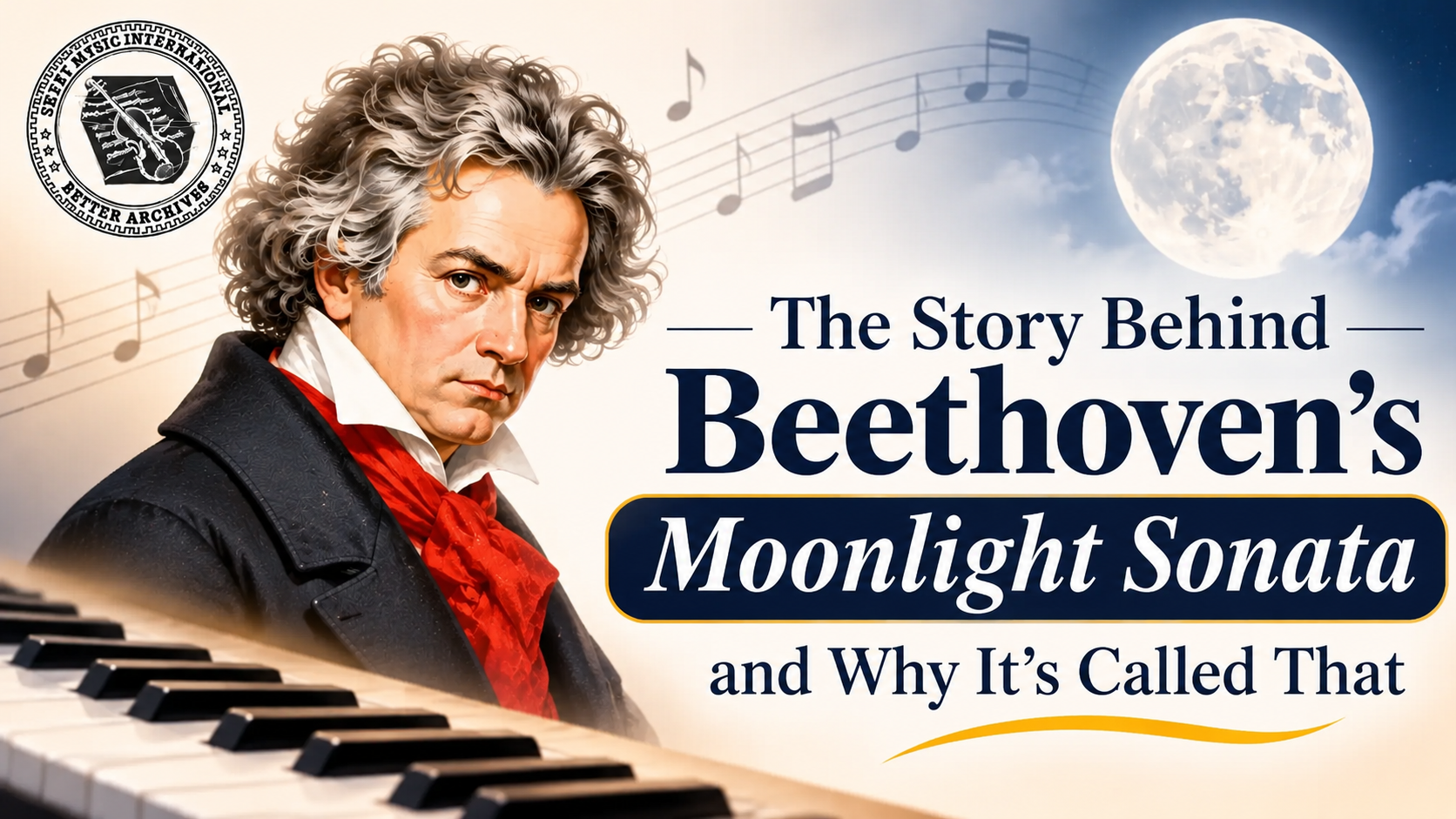
Here's a fun fact to drop at your next dinner party. Beethoven never called his most famous piano piece the Moonlight Sonata. He never heard the name at all. It was given to the piece years after his death, and it stuck so well that almost nobody remembers what he actually titled it.
Here's a fun fact to drop at your next dinner party. Beethoven never called his most famous piano piece the Moonlight Sonata. He never heard the name at all. It was given to the piece years after his death, and it stuck so well that almost nobody remembers what he actually titled it.
So where did the name come from, and what was Beethoven really writing about? The real story is more interesting than the legend.
Beethoven finished the piece in 1801, when he was around 30. Officially it's Piano Sonata No. 14 in C-sharp minor, Opus 27, No. 2. On the title page, he added a subtitle in Italian that translates roughly to "almost a fantasy."
That subtitle matters. Sonatas of the time usually followed a strict pattern, with a fast opening movement. Beethoven flipped the script and opened with a slow, dreamy movement that feels like improvisation. He was bending the rules on purpose, and listeners noticed.
The nickname came from Ludwig Rellstab, a German poet and music critic. In 1832, five years after Beethoven died, Rellstab wrote that the first movement reminded him of moonlight shining on Lake Lucerne in Switzerland.
It was a lovely image, and the public loved it. Publishers began printing the title on scores, and the Moonlight Sonata became the name everyone used. Many musicians since have argued the nickname undersells the music, since the piece is darker and more troubled than a peaceful lake at night. But the name was too good to let go.
Beethoven dedicated the sonata to Countess Giulietta Guicciardi, one of his young piano students. Many stories link the two romantically, and they've fueled the piece's reputation as a love letter in music. Historians treat that idea cautiously, since the evidence is thin.
What's clearer is the timing. Around the same period, Beethoven was struggling with his hearing. Within a year, he wrote a painful letter to his brothers about his growing deafness. It's hard not to hear that sadness in the sonata's opening, with its steady, aching pulse.
The first movement is the one everyone knows. A gentle, rolling triplet pattern sits in the left hand while a quiet melody floats on top. It's slow, hushed, and hypnotic.
The second movement is short and light, almost like a brief smile between two heavy scenes. Franz Liszt once described it as a flower between two abysses.
The third movement explodes. It's fast, stormy, and technically demanding, and it shows the fiery side of Beethoven that the opening only hints at. Most pianists find it far harder than the first movement, and it's rarely attempted by beginners.
Surprisingly, yes, at least the opening. The piano notes in the first movement are not especially complicated. The right and left hands stay in fairly comfortable positions, and the rhythm repeats the same triplet pattern throughout.
The real challenge is control. You have to keep the triplets soft and even while the melody sings above them. That takes patience, but it's a very rewarding skill to build.
If the original feels like too much, simplified versions exist. Looking for classical piano sheet music easy enough to start with? Many arrangements of the first movement slow things down and trim the harder passages, so you can learn the shape of the piece before attempting the full score. Start there, listen to a few recordings, and work up to the original when you're ready.
More than two centuries later, the Moonlight Sonata still shows up in films, commercials, and playlists. Part of the reason is its mood. It sounds like something quiet and private, like a secret you're being let in on.
Part of it is also the story. A man losing his hearing writes some of the most beautiful music ever composed, and a poet gives it a name that outlives them both. It's hard to beat that.
Ready to start playing? Visit Sheet Music International and download free Moonlight Sonata scores, including beginner-friendly arrangements, so you can bring Beethoven's most famous piece to your own piano today.
Ludwig Rellstab, a German music critic, coined the nickname in 1832, five years after Beethoven's death.
He titled it Piano Sonata No. 14 and added the subtitle "almost a fantasy."
The first movement is manageable for patient beginners. The third movement is very difficult.
C-sharp minor, which gives the opening its dark, mysterious sound.
Look for simplified arrangements of the first movement from sites with clear scans and difficulty labels




.png)



Follow us : 


Sheet Music International - Copyright 2026 all rights reserved
| English: Sheet Music (PDF) | Free Scores | French: Sheet Music (PDF) | Free Scores | Greek: Sheet Music (PDF) | Free Scores |
| German: Sheet Music (PDF) | Free Scores | Spanish: Sheet Music (PDF) | Free Scores | Portuguese: Sheet Music (PDF) | Free Scores |
| Italian: Sheet Music (PDF) | Free Scores | Russian: Sheet Music (PDF) | Free Scores | Norwegian: Sheet Music (PDF) | Free Scores |
| Ukrainian: Sheet Music (PDF) | Free Scores | Polish: Sheet Music (PDF) | Free Scores | Dutch: Sheet Music (PDF) | Free Scores |

