
Your Request is under process, Please wait.

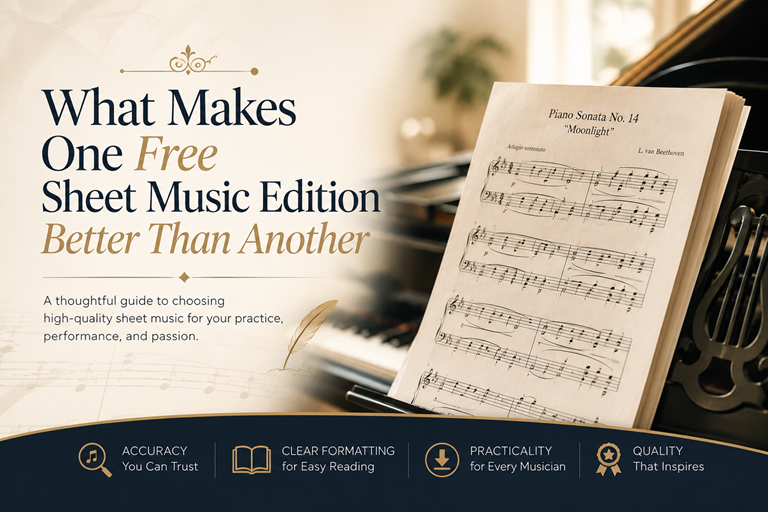
Search for any well-known piano piece online, and you'll find dozens of PDFs claiming to be the "best" version. Open a few side by side, though, and the difference is clear. There's one version that is cleanly readable and feels natural under the fingers. One is cramped, poorly scanned, or missing dynamic markings altogether. When you rely on free sheet music to build a practice library, these differences are more significant than most players realize.
Search for any well-known piano piece online, and you'll find dozens of PDFs claiming to be the "best" version. Open a few side by side, though, and the difference is clear. There's one version that is cleanly readable and feels natural under the fingers. One is cramped, poorly scanned, or missing dynamic markings altogether. When you rely on free sheet music to build a practice library, these differences are more significant than most players realize.
Not all editions are equal, even when it's technically the same work. Here are the things that really make a good score stand out from one that silently drags your progress down.
The first thing to verify in any edition is that the notation itself is correct. Some scans of older public domain texts may have printing errors, measures are faded, or accidentals are missing, and these errors are replicated every time the file is shared.
A trustworthy edition gets the fundamentals right:
● Correct rhythms and note values
● Accurate key signatures
● Clear accidentals
● Properly aligned Piano Notes across both staves
Even one wrong note, repeated through practice without care, can become a habit that's difficult to break up later.
Two versions may have the same notes but still look very different when you read them. The spacing, the size of the font, and the overall layout of the page determine how fast your eyes move when reading music, especially when going through speed-up passages.
Editions that are truly easy on the eyes usually have at least a few of the following characteristics:
● Generous spacing between measures
● Clean, high-resolution printing
● Logical page turns that don't interrupt a phrase
● Legible fingering suggestions
This matters most for beginners working through Classical piano sheet music easy enough to build confidence early on. A crowded page can make a simple piece look far harder than it actually is.
The best editions go beyond bare notation. They include tempo markings, dynamics, articulation, and pedaling suggestions drawn from sound editorial practice. These small additions guide interpretation instead of leaving a student guessing.
Use Fur Elise Sheet Music as an example. Many versions are available online, but the best editions retain Beethoven’s original phrasing and dynamic shading instead of reducing the work to a skeleton melody line. That level of detail often distinguishes the version that teaches you to be a good musician from the one that teaches you the notes.
Some are done by amateurs; others are scans from prints decades old without any quality check. A reliable library checks its editions against authoritative sources, so what you practice genuinely reflects the composer's intentions.
And that’s where a curated collection of free sheet music, as opposed to some random file-sharing site, pays off. Owning several editions of the same work allows you to compare how they handle the material and choose the one that corresponds best to your level.
A well-prepared edition also considers how musicians actually use the page. Are the Piano Notes grouped logically around hand-position changes? Does the layout avoid awkward turns mid-phrase? Small formatting choices like these make a measurable difference during long practice sessions.
Beginner-level and intermediate arrangements are often presented in larger print with simplified fingerings and more obvious measure breaks, allowing students to stay focused on making music rather than figuring out the page.'
Whether you are a beginner with your first pieces or an advanced pianist comparing editions for the same sonata, the quality of an edition will shape your entire learning experience. A good edition makes you form the right habits from day one; a bad one may do just the opposite without you noticing for months, maybe even after you're out of school.
The next time you find yourself browsing through classical scores online, stop and compare a page or two from several before settling on one. Look at the notation, the spacing, the editorial material. That little habit rewards you every time you go to practice.
The best editions don’t just provide notes on a page; they provide clarity, accuracy, and musical direction. Whether you’re looking for Fur Elise, playing through beginner-friendly classical pieces, or browsing no-cost scores from all over the repertoire, the edition you use has a big impact on how well you learn and play.
Discover quality editions from Sheet Music International to make high-quality free sheet music accessible to musicians, while encouraging them to practice and perform with confidence.
Accuracy, readability, editorial markings, and source credibility all determine whether an edition supports genuine learning or introduces bad habits.
No. Quality varies widely depending on the source, scan quality, and whether the notation has been cross-checked for accuracy.
Spacing, fingering suggestions, and editorial choices vary by publisher, which changes how the same notes appear on the page.
Yes, if you use a curated library that reviews scans for accuracy rather than relying on random downloads.
Because it's in the public domain, various publishers and transcribers have released their own versions, which is why comparing editions before practicing is worthwhile.
.png)
Sep 13, 2026
Follow us : 


Sheet Music International - Copyright 2026 all rights reserved
| English: Sheet Music (PDF) | Free Scores | French: Sheet Music (PDF) | Free Scores | Greek: Sheet Music (PDF) | Free Scores |
| German: Sheet Music (PDF) | Free Scores | Spanish: Sheet Music (PDF) | Free Scores | Portuguese: Sheet Music (PDF) | Free Scores |
| Italian: Sheet Music (PDF) | Free Scores | Russian: Sheet Music (PDF) | Free Scores | Norwegian: Sheet Music (PDF) | Free Scores |
| Ukrainian: Sheet Music (PDF) | Free Scores | Polish: Sheet Music (PDF) | Free Scores | Dutch: Sheet Music (PDF) | Free Scores |

