
Your Request is under process, Please wait.


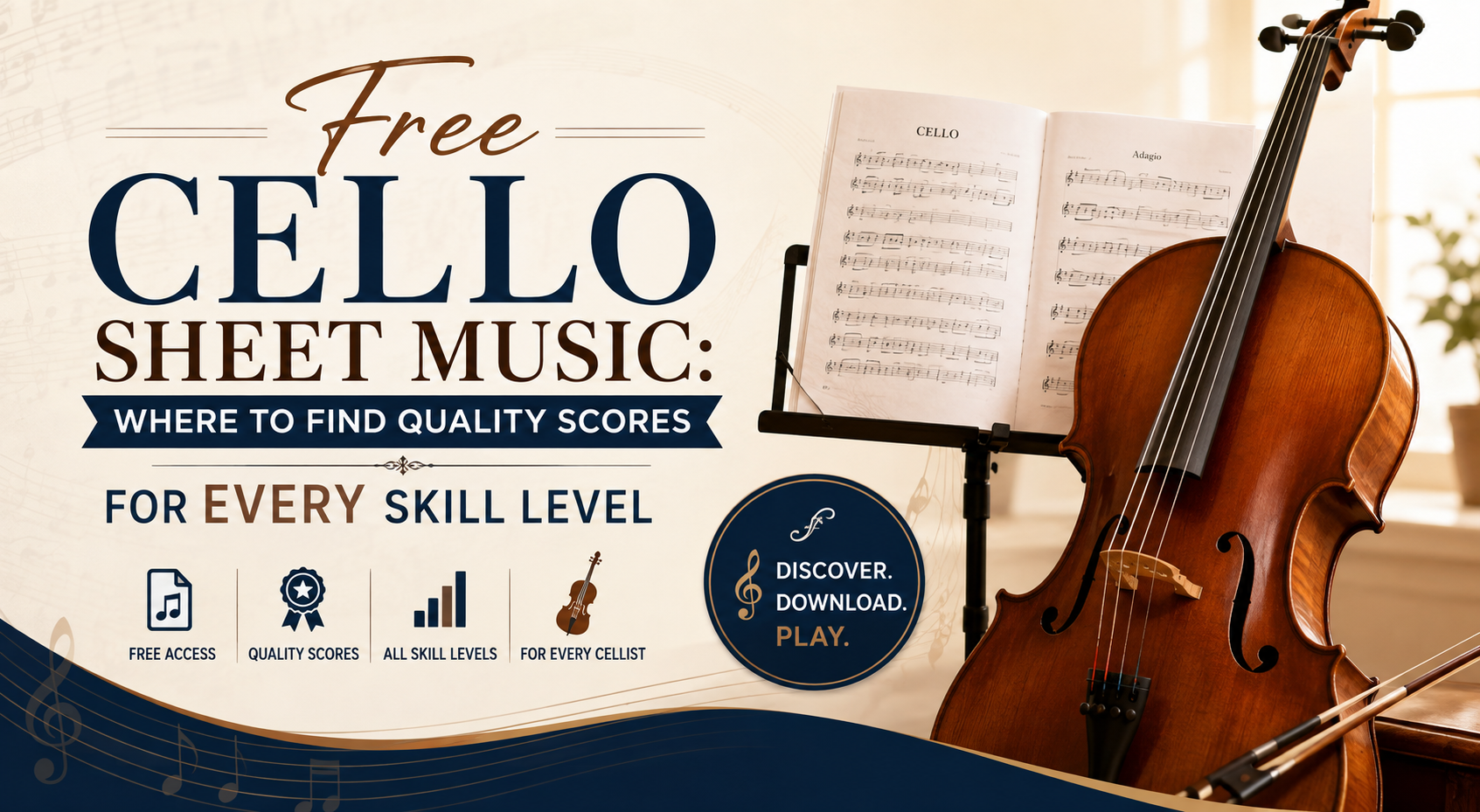
The cello repertoire is rich, expressive, and rewarding, but selecting the right pieces requires structure. A well-organized Cello Repertoire List helps students, teachers, and performers develop technique, refine interpretation, and build performance confidence. Whether preparing for exams, recitals, or personal growth, a thoughtfully curated list ensures steady progress. Access to authentic, professional-quality sheet music further supports learning and makes both classic and lesser-known works easily available.
The cello repertoire is rich, expressive, and rewarding, but selecting the right pieces requires structure. A well-organized Cello Repertoire List helps students, teachers, and performers develop technique, refine interpretation, and build performance confidence. Whether preparing for exams, recitals, or personal growth, a thoughtfully curated list ensures steady progress. Access to authentic, professional-quality sheet music further supports learning and makes both classic and lesser-known works easily available.
An informed and properly chosen repertoire listing is the central focus of every musician's learning journey. It also helps the technical part of the career by taking music that develops a variety of necessary skills like shifting accuracy, bow control, rhythm, and tone consistency, and even allows one to master vibrato.
As players go up on the ladder of difficulty, the selected pieces of music gradually introduce new techniques in a less stressful and motivating manner, hence supporting their development without the risk of being flooded. The right repertoire from the performance point of view ensures the player is properly equipped for formal assessments, competitions, ensembles, and solo performances.
Being artists with a versatile and refined repertoire ready to be drawn from, they are always ready for the different opportunities that come their way. Lastly, the right repertoire has a say in the academic musical knowledge because it points to the historical context, the great composers, and the basic works that cumulatively form modern cello tradition.
Cellists aiming to develop a musical identity that can adapt to various situations need to dive deeply into the music of different classical eras. The Baroque repertoire is the first to do so, offering the technician the opportunity to develop clean articulation, along with composed polyphony. Besides, composers such as Bach and Vivaldi still attract students and provide works that challenge their skills, thus defining their development.
The Classical period, on the other hand, requires perfection, equilibrium, and mastery of the production of tone. Haydn and Boccherini are the main contributors to this era as they created not only beautiful but also dynamic and symmetrical melodies that are excellent for control and phrasing development.
On the contrary, the Romantic repertoire opens the expressive range with rich harmonies and the dramatic gains, with the works of Schumann, Saint-Saëns, and Dvořák marking the complexity and the emotional depth of the pieces. The 20th century and the era after that injected a modern character into the instrument.
Composers of the present day are probing into new techniques, complex rhythms, and unique sounds, which, in a way, make it possible for the cellists to communicate in the musical lingo of the present. All these periods combined form a full-scale learning process that enhances one’s technique as well as artistic expression.
Among these essential digital archives, the Walter Cosand Scores stand out as a respected and carefully organized collection. The scores are restored with attention to readability and historical accuracy, making them suitable for both practice and public performance. The collection features a combination of widely recognized masterpieces and rare or overlooked compositions that offer cellists new opportunities for exploration.
The educators usually endorse these editions for their trustworthiness, while the performers appreciate the opportunity to expand their repertoire with free music that is both commercially and artistically compelling. For every musician who is establishing a balanced repertoire list, these scores are an excellent resource.
Creating an effective repertoire plan requires ongoing evaluation and thoughtful organization. The list should begin with music that aligns with the cellist’s current technical comfort while still providing moderate challenge. Gradually introducing pieces with increasing complexity ensures steady progress without discouragement. A successful list incorporates a mix of lyrical works, étude-based technical compositions, and energetic performance pieces.
Including both unaccompanied solos and works with piano or ensemble accompaniment encourages independence while improving collaborative musicianship. As abilities advance, older pieces should be replaced with new selections that reflect emerging strengths and artistic goals. The most valuable repertoire list is one that evolves continuously and supports lifelong learning.
Sheet Music International supports musicians by offering a wide range of cello repertoire in digital format, making it simple to discover and download music instantly. With reliable engraving quality and an expanding catalogue suitable for beginners through advanced performers, the platform ensures that every musician can find works that match their needs. By featuring public domain collections such as the Walter Cosand Scores, Sheet Music International plays an important role in preserving historic music while enabling modern accessibility.
The pieces a musician studies significantly influence their development and future performance success. With structured guidance, high-quality resources, and access to newly uncovered classical works, building an exceptional Cello Repertoire List becomes an exciting and rewarding process.
Sheet Music International offers the tools cellists need to progress confidently, perform meaningfully, and continue discovering music that inspires both technical and artistic growth.

.png)



Sep 13, 2026



Follow us : 


Sheet Music International - Copyright 2026 all rights reserved
| English: Sheet Music (PDF) | Free Scores | French: Sheet Music (PDF) | Free Scores | Greek: Sheet Music (PDF) | Free Scores |
| German: Sheet Music (PDF) | Free Scores | Spanish: Sheet Music (PDF) | Free Scores | Portuguese: Sheet Music (PDF) | Free Scores |
| Italian: Sheet Music (PDF) | Free Scores | Russian: Sheet Music (PDF) | Free Scores | Norwegian: Sheet Music (PDF) | Free Scores |
| Ukrainian: Sheet Music (PDF) | Free Scores | Polish: Sheet Music (PDF) | Free Scores | Dutch: Sheet Music (PDF) | Free Scores |

