Your Request is under process, Please wait.

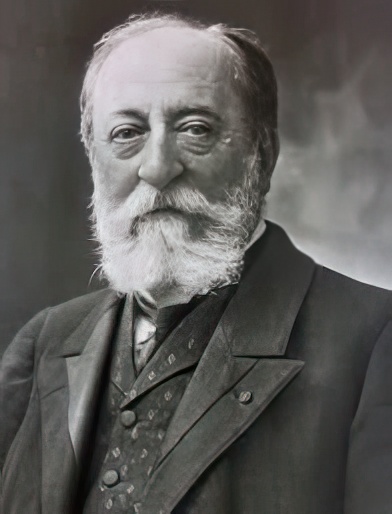
Emmanuel Chabrier (1841-1894)
Download the vibrant and colorful music of Emmanuel Chabrier, a true original of French music. We provide an expertly curated selection of his works as high-quality, printable PDF files, ready for you to enjoy. Instantly access the score to his electrifying orchestral rhapsody España, a piece brimming with Spanish sunshine and rhythm. Pianists can explore his delightful and influential Pièces pittoresques, works celebrated for their wit, charm, and innovative harmonies. Our instantly accessible collection makes it easy to discover the composer whose brilliant music and forward-thinking style profoundly influenced modern French masters like Debussy and
...The Civil Servant Who Painted with Music
Imagine a jovial, witty, and boisterous government bureaucrat, a man who spent his days working for the French Ministry of the Interior. Now, imagine this same man was not only a passionate collector of Impressionist paintings but was also secretly composing some of the most innovative, colorful, and harmonically audacious music of his time. This was Emmanuel Chabrier. He was a man of two worlds: the staid, respectable life of a civil servant and the revolutionary, bohemian world of the Parisian artistic avant-garde. His close friends were not stuffy academics, but painters like Édouard Manet and Claude Monet. While they captured light and life on canvas, Chabrier, with his explosive energy and brilliant ear, captured it all in sound, creating music that would light the way for the future of French composition.
A Provincial Prodigy and Parisian Law
Alexis-Emmanuel Chabrier was born in the provincial town of Ambert, France, in 1841. His musical talent was obvious early on; he began piano lessons at age six and was composing little waltzes by the age of eight. His family, however, followed a familiar path for the 19th-century bourgeoisie: they steered their son toward a secure, professional career. He was sent to Paris to study law, and in 1861 he began his long career as a civil servant.
For nearly twenty years, Chabrier led a double life. By day, he was a diligent, if uninspired, government employee. By night, he threw himself into the artistic heart of Paris. He continued to compose, but largely in private, honing his craft without formal conservatory training. This self-taught path may have been his greatest asset. Unburdened by rigid academic rules, he developed a style that was entirely his own—direct, unpretentious, and full of rhythmic vitality and harmonic surprises. His early circle included the poet Paul Verlaine, and he began to write operettas that, while mostly unfinished, show his natural gift for melody and comedy.
The Impressionist Circle and Wagnerian Passion
Chabrier’s apartment became a lively salon for the leading figures of the avant-garde. He was a close friend of Édouard Manet, who painted two famous portraits of him. Other regular visitors included painters like Monet, Renoir, and Degas. Chabrier's passion for their work was genuine; he amassed one of the first and finest collections of Impressionist art, including Manet's masterpiece, A Bar at the Folies-Bergère. This immersion in the world of modern art deeply shaped his musical aesthetic. Like the Impressionists, he was interested in capturing fleeting moments, sensations, and atmospheres, but he did so with a robust, earthy energy that was far from the hazy ambiguity often associated with musical impressionism.
At the same time, Chabrier developed another, seemingly contradictory, obsession: the music of Richard Wagner. After seeing Tristan und Isolde in Munich, he was completely converted. He wrote to a friend that after ten years of working for the government, he had finally found his true calling. This Wagnerian passion, with its rich orchestration and harmonic depth, would merge with his innate French wit and clarity to create a truly unique sound. In 1880, at the age of 39, he finally resigned from his government post to devote himself entirely to music.
España and a Trip to Spain
Chabrier's breakthrough came from a six-month trip to Spain in 1882. He fell completely in love with the country, its people, and especially its vibrant folk music. He meticulously transcribed the rhythms and melodies of the jota and the malagueña, not as a dry academic, but with infectious enthusiasm. Upon his return to Paris, he channeled all of this raw energy into an orchestral work he initially called a jota. His friend, the composer Charles Lamoureux, immediately recognized its brilliance and programmed it for his orchestra. Retitled España, the rhapsody premiered in 1883 and was a spectacular, overnight success.
The public was electrified by its brilliant orchestration, driving rhythms, and dazzling sonic sunshine. Gustav Mahler declared it "the beginnings of modern music." España made Chabrier famous, but it also typecast him. For the rest of his life, and long after, he was known primarily as the composer of this one exuberant postcard from Spain, a reputation that obscured the depth and seriousness of his other works.
Beyond the Rhapsody: Opera and Piano
Chabrier’s greatest ambition was to succeed in the opera house. His Wagnerian-influenced opera Gwendoline was accepted by the Brussels Opera in 1886 but closed after just two performances when the theater went bankrupt. His comic opera, Le roi malgré lui (The King in Spite of Himself), premiered at the Opéra-Comique in 1887 to great acclaim, but it too was cursed by bad luck: the theater burned down after the third performance. Though rarely staged today, these works are filled with magnificent music and confirm his status as a first-rate musical dramatist.
Perhaps his most lasting and influential works, besides España, are his pieces for solo piano. The 1881 collection Pièces pittoresques is a landmark of French piano music. The ten pieces, with descriptive titles like "Scherzo-valse" and "Idylle," are masterpieces of charm, wit, and startling harmonic invention. The great French composer Francis Poulenc later said, "I can state that my entire pianistic evolution comes from the 'Idylle.'" These pieces, along with his later Bourrée fantasque, directly paved the way for the piano music of Claude Debussy and Maurice Ravel.
A Legacy of Influence
In his final years, Chabrier suffered from a debilitating illness, likely syphilis, which led to depression and a decline in his mental faculties. He died in Paris in 1894 at the age of just 53, leaving his final opera, Briséïs, unfinished.
While his own career was fraught with frustration and bad luck, Emmanuel Chabrier's influence was immense. He was the vital link between the older Romantic generation and the modern French school. Composers from Debussy and Ravel to Satie and Poulenc revered him as a liberator. They admired his harmonic freedom, his rhythmic audacity, and his rejection of stuffy academicism. Ravel, who claimed he could play all of Chabrier's piano music by heart, famously stated that the opening measures of Le roi malgré lui "changed the course of harmony in France." Chabrier was the breath of fresh air French music desperately needed, a man whose irrepressible joie de vivre and brilliant musical mind opened a door to the 20th century.
Myers, Rollo. Emmanuel Chabrier and His Circle. J. M. Dent & Sons, 1969.
Delage, Roger. Chabrier. Minkoff, 1999. (The definitive scholarly biography, in French).
Nichols, Roger. The Harlequin Years: Music in Paris 1917-1929. University of California Press, 2002. (Contains context on Chabrier's influence on Les Six).
Howat, Roy. The Art of French Piano Music: Debussy, Ravel, Fauré, Chabrier. Yale University Press, 2009.
Follow us : 


Sheet Music International - Copyright 2026 all rights reserved
| English: Sheet Music (PDF) | Free Scores | French: Sheet Music (PDF) | Free Scores | Greek: Sheet Music (PDF) | Free Scores |
| German: Sheet Music (PDF) | Free Scores | Spanish: Sheet Music (PDF) | Free Scores | Portuguese: Sheet Music (PDF) | Free Scores |
| Italian: Sheet Music (PDF) | Free Scores | Russian: Sheet Music (PDF) | Free Scores | Norwegian: Sheet Music (PDF) | Free Scores |
| Ukrainian: Sheet Music (PDF) | Free Scores | Polish: Sheet Music (PDF) | Free Scores | Dutch: Sheet Music (PDF) | Free Scores |