Your Request is under process, Please wait.

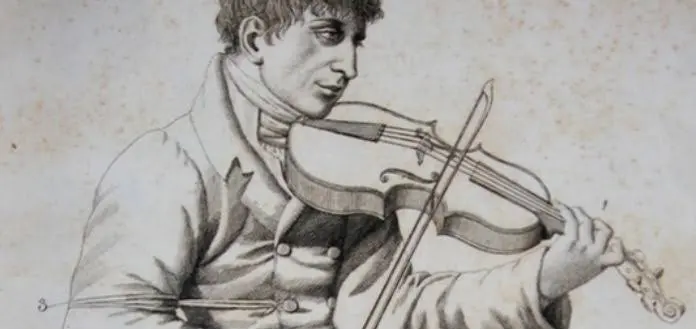
Bartolomeo Campagnoli (1751–1827)
Download free sheet music from Bartolomeo Campagnoli.
Bartolomeo Campagnoli stands as one of the most significant figures in the transition of violin and viola pedagogy from the late 18th century into the early 19th century. Born in Cento, Italy, he received his musical foundation under the guidance of Pietro Nardini, the celebrated pupil of Giuseppe Tartini. Campagnoli became a tireless traveler, carrying the refined "Italian style" of string playing across Europe, holding prestigious positions in Rome, Florence, and eventually serving as the concertmaster of the Gewandhaus Orchestra in Leipzig. His career was defined by a
...The Architect of the Noble Style: Bartolomeo Campagnoli’s European Odyssey
An illuminating anecdote regarding Bartolomeo Campagnoli concerns his legendary encounter with the violin virtuoso Rodolphe Kreutzer. While Campagnoli was established in Leipzig, he was known as a staunch defender of the traditional Italian school of playing he had learned from Pietro Nardini. When Kreutzer—the dedicatee of Beethoven’s famous sonata—visited Leipzig, the two masters engaged in a series of musical exchanges. Campagnoli, though impressed by the modern, explosive French style of the younger generation, remained unmoved in his dedication to the "bel canto" style of the violin. He reportedly remarked that while the newer school could produce more sound, it could not produce more soul. This steadfastness earned him the nickname "the noble Italian," a testament to his belief that the violin should always imitate the human voice in its most refined state. His dedication was so profound that even in his seventies, he was still actively revising his pedagogical methods to ensure that his students understood the historical weight of every bow stroke.
Formative Years and the Nardini Influence Campagnoli’s musical journey began in the shadow of the great Giuseppe Tartini. By studying with Pietro Nardini in Florence, Campagnoli became a direct heir to the "School of Nations" in Padua. This education focused on the development of a "singing" tone and a deep understanding of ornamentation. Before moving north, he spent several years as a violinist in the opera houses of Rome and Florence, where he was immersed in the vocal traditions of Italy. This operatic background is vital to understanding his compositions; his melodies are often structured like arias, requiring a performer to "breathe" through the instrument.
The Traveling Virtuoso Unlike many of his contemporaries who remained tied to a single court, Campagnoli was a true cosmopolitan. His travels took him to the courts of Poland, Sweden, and Denmark. In 1797, he was appointed concertmaster of the prestigious Gewandhaus Orchestra in Leipzig, a position he held for over two decades. Leipzig was then, as it is now, one of the most important musical hubs in Europe. During his time there, he witnessed the rise of Ludwig van Beethoven and the shifting tastes of the public. Despite the changing musical landscape, Campagnoli maintained a reputation for impeccable taste and a technical facility that was crystalline rather than cloying.
The 41 Caprices and Viola Pedagogy While many composers of his era focused exclusively on the violin, Campagnoli made an indelible mark on the world of the viola. His 41 Caprices for Viola, Op. 22, are widely considered the "Gold Standard" of viola studies. Before Campagnoli, the viola was often treated as a secondary instrument, but his caprices treated it with the same technical rigor and expressive potential as the violin. These works cover a vast range of techniques, from complex double-stops to rapid-fire string crossings, all while maintaining a distinctly musical and pedagogical purpose. For the modern violist, downloading the sheet music for these caprices is not merely an exercise in technique, but an essential rite of passage.
Chamber Works and the Art of the Duet Campagnoli was a prolific composer of chamber music, particularly for two violins or violin and viola. His Six Duos for Violin and Viola, Op. 14, are excellent examples of his ability to create a full, orchestral sound with just two instruments. In these works, the parts are often equal in difficulty, allowing for a true dialogue between the players. His writing demonstrates a sophisticated understanding of harmony and counterpoint, influenced by his friendship with Luigi Cherubini and his exposure to the works of Haydn and Mozart.
The New Method for Violin In 1824, toward the end of his life, Campagnoli published his A New Progressive Method on the Mechanism of Violin Playing. This work was a massive undertaking, intended to synthesize the Italian traditions of the past with the technical requirements of the present. In it, he detailed everything from the proper way to hold the bow to the execution of the most complex trills. The method reflects his philosophy that "the mechanical part of music should always be at the service of the expressive part." It remains a valuable resource for scholars of historical performance practice, providing a direct link back to the 18th-century masters.
Legacy and Modern Reception Following his death in 1827, Campagnoli’s music fell somewhat out of favor as the flamboyant virtuosity of Niccolò Paganini took center stage. However, the late 20th and early 21st centuries have seen a significant revival of interest in his works. Violists, in particular, have reclaimed him as a foundational figure. Recording projects by modern string players have highlighted the elegance and structural integrity of his concertos and sonatas. When playing a Campagnoli work, one is struck by its poise; it is music that demands discipline, yet rewards the player with a sense of classical balance and lyricism.
Conclusion for Program Notes For a concert program, Bartolomeo Campagnoli should be introduced as a guardian of the classical flame. His music represents a time when the violin was considered the most expressive of all instruments because of its proximity to the human voice. Performers and audiences alike will find in his music a refreshing clarity—a reminder that beauty often lies in the precision of the phrase and the purity of the tone. Whether through the rigorous study of his caprices or the joyful performance of his duets, engaging with Campagnoli’s scores is an engagement with the very heart of the Italian string tradition. He was a master who believed that music was a noble pursuit, and his compositions remain a testament to that high ideal.
Boyden, David D. The History of Violin Playing from its Origins to 1761. Oxford University Press, 1965.
Campbell, Margaret. The Great Violists. Traverse Press, 1980.
Stowell, Robin. The Cambridge Companion to the Violin. Cambridge University Press, 1992.
Creighton, James. Discopaedia of the Violin. University of Toronto Press, 1974.
Riley, Maurice W. The History of the Viola. Braun-Brumfield, 1980.
Follow us : 


Sheet Music International - Copyright 2026 all rights reserved
| English: Sheet Music (PDF) | Free Scores | French: Sheet Music (PDF) | Free Scores | Greek: Sheet Music (PDF) | Free Scores |
| German: Sheet Music (PDF) | Free Scores | Spanish: Sheet Music (PDF) | Free Scores | Portuguese: Sheet Music (PDF) | Free Scores |
| Italian: Sheet Music (PDF) | Free Scores | Russian: Sheet Music (PDF) | Free Scores | Norwegian: Sheet Music (PDF) | Free Scores |
| Ukrainian: Sheet Music (PDF) | Free Scores | Polish: Sheet Music (PDF) | Free Scores | Dutch: Sheet Music (PDF) | Free Scores |