
Your Request is under process, Please wait.

.png)
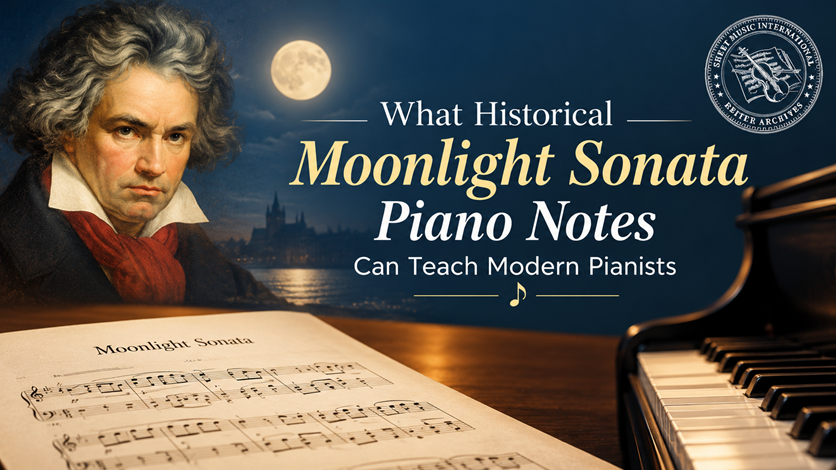
What comes to your mind when you hear the name Moonlight Sonata? For many, its first notes bring a sense of quiet reflection, a mix of melancholy and serenity that feels almost timeless. This masterpiece is officially known as Piano Sonata No. 14 in C sharp minor and was composed by Beethoven in the early 1800s. It quickly grew into one of the most beloved works in the piano repertoire. Unlike many sonatas of its era, it begins with a slow movement that captures the attention of listeners who feel deeply personal.
What comes to your mind when you hear the name Moonlight Sonata? For many, its first notes bring a sense of quiet reflection, a mix of melancholy and serenity that feels almost timeless. This masterpiece is officially known as Piano Sonata No. 14 in C sharp minor and was composed by Beethoven in the early 1800s. It quickly grew into one of the most beloved works in the piano repertoire. Unlike many sonatas of its era, it begins with a slow movement that captures the attention of listeners who feel deeply personal.
The Moonlight Sonata remains important in music education, not just because it sounds beautiful. This is because it teaches key musical skills. Its slow movement helps students learn how to play with smooth phrasing and control. In the later section of the masterpiece, you get to see changes in tempo and dynamics that help piano learners build stronger expressive ability.
Students also learn to listen closely to balance and tone, which are essential skills in classical music training. This combination of emotional depth and musical structure is what keeps Moonlight Sonata at the heart of lessons and performances even today.
The Moonlight Sonata has become a valuable piece in music education because it teaches more than just notes. It opens the door to musical understanding and expression. Students often connect with its calm movement before moving on to the more active later sections, which help build skills like timing and emotional contrast.
Teachers use this sonata to show how a piece can sound lyrical and controlled. It still needs feeling and expression, so learners pay attention to balance, phrasing, and mood as they play. By working with this masterpiece, pianists begin to grasp how music can tell a story without words and how changes in tempo and intensity create emotional impact. This makes the piece a powerful tool for shaping both technical ability and artistic awareness in classical music study. Let’s know how Beethoven's Sonata No. 14 contributes to classical music education.
Have you noticed how Moonlight Sonata feels like a conversation rather than just notes? When students first begin this piece, they learn more than finger positions; they learn how music speaks. Playing this sonata helps pianists shape phrases so they sound smooth, not mechanical.
It teaches a sense of timing and breath within the music, helping learners feel the flow from one phrase to the next. This deep engagement with sound helps students think like musicians, not just players. Over time, using Moonlight Sonata in lessons builds an instinct for expressive playing that stays with them as they study more pieces.
Learning Moonlight Sonata isn’t just about memorising notes; it teaches students when and how to adjust volume and touch. The piece begins slowly, but later it has more intense sections, so learners must pay attention to how loud or soft they play. This ability to control sound helps make the music feel alive, not flat or mechanical.
Practising these shifts also makes it easier to approach other works that rely on expressive changes, such as the Fur Elise sheet music, where dynamics play a big role in bringing the melody to life. As students build this skill, they become more confident and expressive pianists overall.
Have you ever wondered how classical musicians build a solid foundation for varied repertoire? A good cello repertoire list includes pieces that push technique, coordination, and musical listening, and the same idea applies at the piano. When a pianist approaches demanding works like those in a strong repertoire list, they develop their piano learning techniques.
Practicing such pieces helps a learner build confidence with complex passages, balance between hands, and control over complex rhythms. These technical skills become a core part of a musician’s toolkit, making future pieces feel more approachable and musically rewarding.
Encourages Deep Listening
Deep listening goes beyond hitting the right notes; it’s about hearing every nuance in the music. With Moonlight Sonata, students learn to listen to the subtle shifts in volume, tone, and pace rather than just focusing on finger placement.
This piece asks musicians to balance melody and accompaniment, to pay attention to how the left hand supports the right, and to notice how tiny changes alter the overall feel. As learners become better listeners, they can interpret music more thoughtfully and respond with feeling, which is an essential part of classical music study.
Have you ever felt moved by listening to a familiar tune? When students work with the Fur Elise sheet music and the Beethoven Sonata, they begin to see how emotion is woven into every phrase. The playful opening, the tender middle section, and the expressive dynamics give learners a chance to explore a range of feelings through their fingers.
Playing with emotional awareness helps students bring music to life, making performances feel personal. Over time, this emotional insight grows alongside technical skill, helping musicians connect deeply with every piece they touch
Moonlight Sonata continues to be valued in music learning because it encourages students to think and feel deeply about the music they play. This journey helps young pianists become thoughtful performers who listen closely and play with purpose. Because of this rich blend of musical understanding and emotional depth, it remains a meaningful part of classical music education today.
At Sheet Music International, we offer sheet music from all the great composers, from Bach to Beethoven and beyond, so you can explore the full spectrum of classical music. Whether you are learning Moonlight Sonata or discovering new favorites, our collection supports your growth as a musician at every stage.
.png)

Sep 13, 2026

Follow us : 


Sheet Music International - Copyright 2026 all rights reserved
| English: Sheet Music (PDF) | Free Scores | French: Sheet Music (PDF) | Free Scores | Greek: Sheet Music (PDF) | Free Scores |
| German: Sheet Music (PDF) | Free Scores | Spanish: Sheet Music (PDF) | Free Scores | Portuguese: Sheet Music (PDF) | Free Scores |
| Italian: Sheet Music (PDF) | Free Scores | Russian: Sheet Music (PDF) | Free Scores | Norwegian: Sheet Music (PDF) | Free Scores |
| Ukrainian: Sheet Music (PDF) | Free Scores | Polish: Sheet Music (PDF) | Free Scores | Dutch: Sheet Music (PDF) | Free Scores |

