Your Request is under process, Please wait.

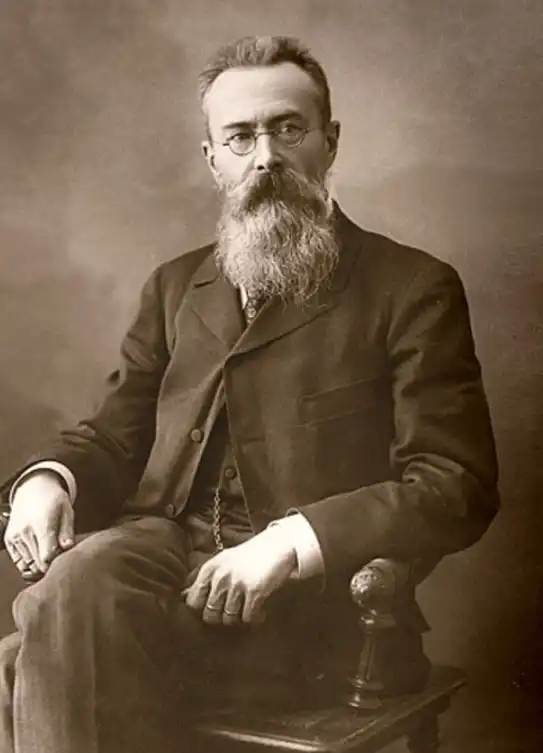
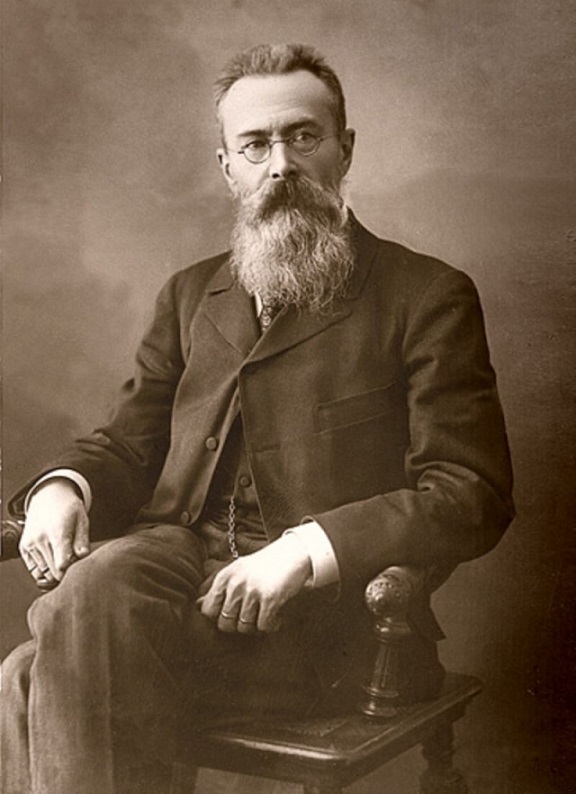
Nikolai Rimsky-Korsakov’s first opera, The Maid of Pskov (Pskovityanka), is a vast, turbulent, and powerful historical epic. It is the quintessential opera of "The Mighty Handful," the group of nationalist composers who sought to create a "true" Russian art. Based on a play by Lev Mei, the opera is set in the 16th century and tells the story of the free city of Pskov as it is about to be crushed by the "terrible" Tsar, Ivan the Terrible. At the center of this national drama is a personal one: the Tsar's discovery that the young, "free-spirited" Olga is his
...Two Roommates and the Birth of Russian Opera
During the 1870s, two young, brilliant, and fiercely ambitious composers shared an apartment in St. Petersburg, working at opposite ends of the same piano. They would work all day, sharing ideas, arguing, and playing their new creations for each other every evening. One was Modest Mussorgsky, and the opera he was writing was Boris Godunov. The other was Nikolai Rimsky-Korsakov, and the opera he was writing was The Maid of Pskov. It is impossible to overstate the importance of this "shared kitchen" in the history of music. Boris and Pskov are the two "founding fathers" of Russian music drama. Both are sprawling, "un-Wagnerian" historical epics based on Pushkin-esque themes. Both reject Italian bel canto in favor of a "realistic" Russian vocal style. And, most importantly, both feature a charismatic, psychologically complex, and "guilty" Tsar at their center, written for a bass. While Mussorgsky’s Boris is the raw, jagged, and revolutionary masterpiece, Pskov is its more lyrical, polished, and "nationalist" twin. It was the opera that proved the ideals of "The Mighty Handful" could conquer the grand stage.
A Manifesto for "The Mighty Handful"
The Maid of Pskov was not just an opera; it was a manifesto. Rimsky-Korsakov was a member of "The Mighty Handful" (or "The Five"), a group of nationalist composers (including Mussorgsky, Alexander Borodin, César Cui, and Mily Balakirev) who were dedicated to creating a "Russian" art, free from the "contamination" of German symphonies and Italian arias. Their "bible" was Mikhail Glinka’s Ruslan and Lyudmila. Pskov was the group's first major attempt to put their ideals into practice on the grandest scale. The opera is, by design, a "people's drama." The true hero of the opera is not an individual, but the people of Pskov, represented by the massive, powerful, and central choruses. Rimsky-Korsakov, a "musical ethnographer," built the entire score on authentic Russian folk songs, using their unique, modal harmonies and irregular rhythms to create a sound that was, to the 1873 audience, unmistakably Russian.
The "Terrible" Tsar: A Psychological Portrait
The opera's greatest and most revolutionary achievement is the character of Tsar Ivan the Terrible. This is not a one-dimensional, "monster" villain. He is the historical, complex, and terrifyingly human figure—pious and paranoid, brilliant and brutal. This was a direct challenge to the Italian tradition, where the "villain" (like Scarpia in Puccini's Tosca) was often a mustache-twirling baritone, and the "hero" was the tenor. Here, the tenor (Mikhail Tucha) is the "romantic lead," but he is a secondary character. The opera's entire dramatic and psychological weight rests on its two basses: the noble Prince Tokmakov (representing the old "republican" Pskov) and the Tsar himself. Ivan's entrance in Act II is one of the most powerful scenes in Russian opera. He does not enter with a "rage aria." He enters in darkness, in the middle of a veche (a public assembly), and the music that represents him is a dark, brooding, and obsessive leitmotif in the low brass. His great "aria" is a quiet, terrified, and superstitious monologue, as he is haunted by the ghost of his past, a moment that is a direct parallel to the "clock scene" in Boris Godunov.
A Career of "Revisions": The Wagnerian Problem
The Maid of Pskov is almost three different operas. Rimsky-Korsakov was a relentless, almost obsessive "reviser," and he completely rewrote the opera twice over his 30-year career. The original 1873 version is the "purest" "Mighty Handful" opera—a raw, anti-lyrical, "number opera" built on folk tunes and Mussorgsky-like "realistic" recitative. But as the composer grew older, his tastes changed. He famously, and controversially, fell under the spell of Richard Wagner. He began to feel his early works were "crude" and "amateurish." His final, 1892 revision of Pskov is a completely different work. He smoothed out the "radical" harmonies, cut many of the "blockbuster" folk choruses, and re-composed the entire opera as a "music drama" in the Wagnerian style, with "endless melody," a more complex web of leitmotifs, and a lush, "symphonic" orchestral texture. This final version is more "polished," but many critics feel it lost the raw, "barbaric" power of the original. This internal conflict—the "Russian nationalist" vs. the "European-trained symphonist"—would define Rimsky-Korsakov's entire career, most famously in his "re-orchestration" of Boris Godunov, which he "corrected" and made more "Wagnerian" after Mussorgsky's death.
Music of "Atmosphere" and "Action"
While Rimsky-Korsakov was not yet the "master of the orchestra" he would become with Scheherazade or The Golden Cockerel, Pskov is filled with moments of brilliant musical painting. The opera's most famous orchestral excerpt is the Act III "Tsar's Hunt and Storm," a thrilling, programmatic interlude that depicts the chaos of the hunt, a building tempest, and the Tsar's rage. The opera is also a "leitmotif" opera, a technique he borrowed from Wagner (via Liszt). The key themes are the brooding, chromatic "Ivan the Terrible" motif; the "Pskov" theme, which is a broad, folk-like melody representing the "free city"; and the lyrical, tender theme for Olga, which is revealed to be the same theme as Ivan's, tying them together by blood long before the libretto does. The opera's two "romantic" leads, Olga and Tucha, are given the most "Italianate" music—soaring, lyrical melodies that show that even in his most "nationalist" phase, Rimsky-Korsakov, like Tchaikovsky, could not resist the power of a great bel canto tune.
A Troubled Masterpiece
The Maid of Pskov has never achieved the worldwide popularity of Boris Godunov, but it is, in many ways, just as important. It is a "darker," more historically "grounded" opera than the "fairy-tale" epics Rimsky-Korsakov would later write. It established the "historical epic" as a central genre of Russian art, a tradition that would be carried on by Borodin in Prince Igor and, much later, by Prokofiev in War and Peace. It is a sprawling, magnificent, and "flawed" masterpiece from a 28-year-old composer, a "snapshot" of a genius, and a nation, forging a new identity.
Prologue (The Boyarina Vera Sheloga)
(This one-act opera, composed 5 years after the premiere, serves as the Prologue) In the house of Prince Tokmakov. The Boyarina Vera Sheloga, Tokmakov's sister-in-law, is being comforted by her nurse. Vera is terrified. She has just given birth to a daughter, Olga, but the father is not her husband. She confesses that, while her husband was away, she was "wooed" and "overpowered" by a mysterious, terrifying visitor. She does not know his name, only that he is the Tsar's "terrible" guest. As she sings, she is haunted by the man's "fiery" gaze. She makes her nurse swear to raise the child, Olga, as Tokmakov's own.
Act I: The Free City
Pskov, 1570. In the garden of Prince Tokmakov (the Tsar's viceroy in Pskov), the people are singing. Princess Olga, now a young woman, is with her nurses. She is in love with Mikhail Tucha, a fiery, young, "republican" leader. Tucha arrives for a secret rendezvous. They sing a passionate love duet, but Tucha is grim: he has heard that the Tsar, Ivan the Terrible, is on the march, having just massacred the city of Novgorod. He fears Pskov is next. He asks Olga to flee with him, but she is torn. Prince Tokmakov arrives. He reveals to his friend Matuta that Olga is not his daughter, but the child of his late wife's sister, Vera Sheloga. He does not know who the father is. Olga, who has been hiding, overhears this and is shattered. At that moment, the alarm bell rings. The Tsar is approaching. Tucha and the people of Pskov gather in the town square for a veche (a public assembly) and vow to fight for their freedom.
Act II: Tsar Ivan the Terrible
In the Pskov town square, at night. The people are in a state of panic, but Tokmakov, in a show of "Russian" submission, orders them to open the city gates and meet the Tsar with "bread and salt." The Tsar's vanguard arrives, and the massive, brooding figure of Ivan the Terrible enters. He is suspicious, paranoid, and grim. He sings his great monologue, haunted by the "ghosts" of his past. He does not trust Tokmakov. He orders the people to kneel. As he does, Olga appears, offering him the "bread and salt." Ivan is stunned. He stares at her, recognizing her "fiery" eyes. He asks Tokmakov who she is. Tokmakov, terrified, tells him the truth: she is the daughter of Vera Sheloga. Ivan, in a sudden, violent realization, understands: he is her father. His entire demeanor changes. He rises, his rage gone. He turns to his soldiers and orders them to "put away their swords." He blesses the people of Pskov. "God save the free city of Pskov!" he declares. The act ends as the people, stunned and saved, praise their "merciful" Tsar.
Act III: The Forest and the Finale
In the forests outside Pskov. Olga, in a state of confusion, has arranged to meet Tucha. She is now a "Princess," the daughter of the Tsar, and she is afraid. Tucha, still a rebel, begs her to flee with him. Before she can decide, they are ambushed by Matuta (Tucha's rival), who captures Olga. The Tsar and his hunting party, in the midst of a great storm, arrive on the scene. Tucha and his rebels attack the Tsar's men, and in the confusion, Tucha is wounded. The Tsar, seeing Olga, orders his men to "seize her." A final battle breaks out. Tucha is captured. Olga, trying to protect her lover, rushes forward, but she is struck by a stray bullet and falls. Tsar Ivan, seeing her fall, lets out a cry of agony. He rushes to her, cradling her in his arms. The music, which was a "battle," now becomes a "lament." He is no longer a Tsar; he is a "father," a "pitiless, old, gray-haired man." He orders Tucha to be "freed," as he is "too poor a wretch to kill." The opera ends as Ivan the Terrible weeps, alone and broken, over the body of his daughter.
Follow us : 


Sheet Music International - Copyright 2025 all rights reserved
| English: Sheet Music (PDF) | Free Scores | Français: Partitions (PDF) | Musique gratuite | Ελληνικά: Παρτιτούρες (PDF) | Δωρεάν μουσική |
| Deutsch: Noten (PDF) | Kostenlose Partituren | Español: Partituras (PDF) | Música impresa | Português: Partituras (PDF) | Música gratuita |
| Italiano: Spartiti (PDF) | Partiture musicali | Русский: Ноты (PDF) | Бесплатные партитуры | Norsk: Noter (PDF) | Gratis noter |
| Українська: Ноти (PDF) | Безкоштовні партитури | Polski: Nuty (PDF) | Darmowe nuty | Nederlands: Bladmuziek (PDF) | Gratis partituren |