Your Request is under process, Please wait.

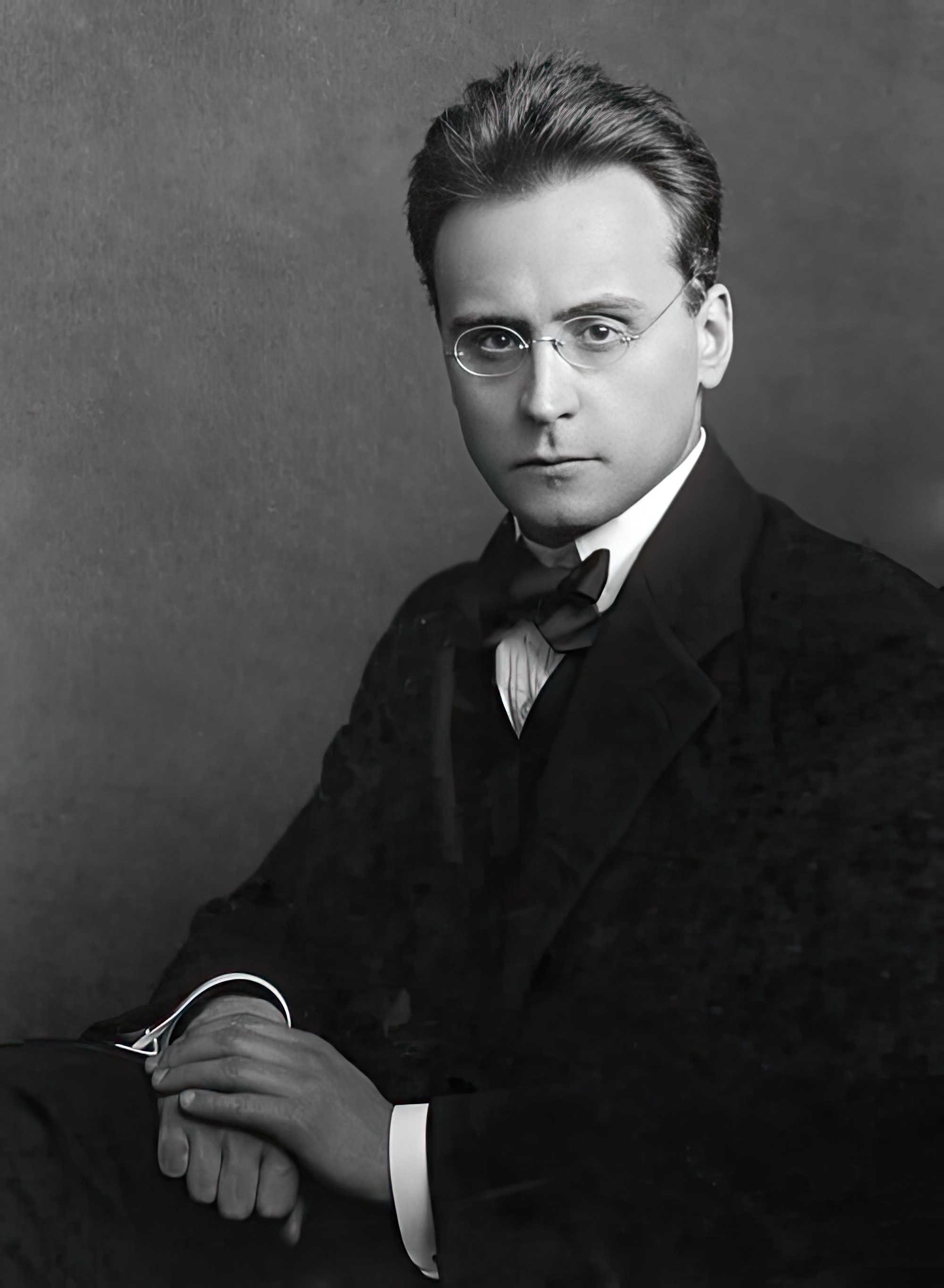
Anton Webern (1883-1945)
Download free sheet music from Anton Webern.
Enter the crystalline sound world of Anton Webern, a composer whose intensely concentrated music revealed a universe in a grain of sand. We offer a curated selection of his revolutionary works as high-quality, printable PDF files, available for free download. Webern, a core member of the Second Viennese School, took the innovations of his teacher Arnold Schoenberg to their logical extremes, creating brief, aphoristic compositions where every single note, rest, and dynamic marking is charged with meaning. His sparse, pointillistic scores are a fascinating challenge for performers and an essential
...The Architect of Silence
On the night of September 15, 1945, just months after the end of World War II in Europe, the small Austrian town of Mittersill was under American occupation. The 61-year-old composer Anton Webern stepped outside his son-in-law’s house to smoke a cigar, careful not to disturb his sleeping grandchildren. It was after the 9 p.m. curfew. An American army cook, startled by the encounter and possibly confused by a nearby black-market investigation, fired three shots. Webern stumbled back into the house and collapsed, murmuring to his wife, "It's over." This sudden, senseless death was a tragic and deeply ironic end for a man whose entire artistic life was a meticulous, near-monastic search for perfect order and absolute structural purity. He was an architect of sound and silence whose quiet, radical music would, against all odds, become one of the most powerful and influential forces on the generation of composers that followed.
Early Life and Schoenberg's Circle
Anton Friedrich Wilhelm von Webern was born in Vienna on December 3, 1883, into a high-ranking aristocratic family. (He would later drop the noble "von" as a republican gesture). He received a thorough musical education from a young age, learning piano, cello, and music theory. Unusually for a major composer, he also pursued a formal academic path, enrolling at the University of Vienna and earning a doctorate in musicology in 1906. His dissertation on the music of the Renaissance master Heinrich Isaac was crucial; his deep study of the intricate polyphonic lines of the 15th-century Franco-Flemish school would profoundly inform the complex, crystal-clear counterpoint of his own mature works.
The most important event of his life occurred in 1904, when he sought out Arnold Schoenberg and became one of his first private pupils. In Schoenberg’s informal but intensely demanding classes, Webern found his master. He, along with his slightly older and more outgoing colleague Alban Berg, became part of the core triumvirate of what would later be called the Second Viennese School. The three men shared an almost religious devotion to the art of composition and a fierce loyalty to one another in the face of a hostile and uncomprehending musical world.
From Atonality to Aphorism
Webern’s compositional journey mirrored that of his teacher. He began with lush, late-Romantic works, but quickly followed Schoenberg into the uncharted territory of free atonality. Yet, from the very beginning, Webern’s voice was distinct. His atonal works were even more radical, more compressed, and more sparse than Schoenberg's. He became the ultimate musical miniaturist, creating what are often called "aphoristic" compositions. Works like his Six Bagatelles for String Quartet, Op. 9 (1913) are shockingly brief; the entire cycle lasts about three and a half minutes. Schoenberg wrote in the preface to the score, "Consider what moderation is required to express oneself so briefly. You can stretch every glance out into a poem, every sigh into a novel. But to express a novel in a single gesture, a joy in a single breath—such concentration can only be present in proportion to the absence of self-pity."
In these pieces, Webern perfected a technique known as Klangfarbenmelodie (tone-color melody), a concept first articulated by Schoenberg. Instead of a melody being played by a single instrument, its individual notes are passed between different instruments, creating a shimmering, fractured line of constantly changing timbres. The effect is often described as "pointillistic," a term borrowed from painting, where a larger image is created from tiny, distinct dots of color. For Webern, silence was as important as sound; the rests in his music are not empty spaces but charged moments of tension and resonance.
Embracing the Twelve-Tone Method
When Schoenberg unveiled his twelve-tone method in the early 1920s, Webern embraced it with the fervor of a true believer. The system, which provided a logical framework for ordering atonal music, was perfectly suited to his desire for organic unity and structural integrity. In fact, he often applied the principles of the tone row with even more rigor and elegance than Schoenberg himself. Webern was fascinated by symmetry and palindromic structures, and he often constructed his tone rows so that their inverted or retrograde forms were identical to the original.
This structural purity is on full display in his mature masterpieces, such as the Symphony, Op. 21 (1928) and the Concerto for Nine Instruments, Op. 24 (1934). The Symphony is a marvel of musical geometry, a two-movement work built on a foundation of complex canons and symmetrical relationships, all derived from a single, highly ordered tone row. Yet, for all their mathematical precision, these works are not cold or academic. They are intensely expressive, conveying a delicate, crystalline lyricism that is unique to Webern. He saw his compositional method not as a set of rules, but as a way to tap into the universal laws of nature and art.
A Life of Obscurity and Tragedy
Despite the revolutionary nature of his music, Webern lived his entire life in relative obscurity. He never achieved the public success of Berg, whose opera Wozzeck was an international sensation. Instead, Webern eked out a modest living as a conductor for various Viennese workers' choirs and orchestras, and by giving private lessons.
The rise of Nazism in the 1930s was a disaster for him. After the 1938 Anschluss (the annexation of Austria by Germany), his music—like that of Schoenberg—was officially labeled "cultural Bolshevism" and "degenerate art" and was effectively banned. He lost his conducting positions and was forced into a state of "internal exile," working as a lowly proofreader and copyist for his publisher, Universal Edition, to support his family. His personal politics during this time remain a subject of painful debate; while he was no Nazi, private letters reveal a troubling, if perhaps politically naive, strain of German nationalism that led him to welcome Hitler's initial rise.
Death and Posthumous Legacy
After his tragic death, Webern's music was poised for an astonishing second life. During the war, his scores had been quietly studied by a new generation of composers. In the immediate postwar years, at venues like the Darmstadt International Summer Courses for New Music, young composers such as Pierre Boulez and Karlheinz Stockhausen were searching for a way to make a complete break from the past. They rejected the perceived Romanticism of Schoenberg and Berg, but in the abstract purity, structural logic, and textural clarity of Webern's music, they found their new messiah.
They saw Webern not as the end of the Romantic tradition, but as the true beginning of a new, "totally serialized" music, where not just pitch, but rhythm, dynamics, and articulation could all be organized according to serial principles. For a time, Webern became the single most important influence on the global avant-garde. Even the great Igor Stravinsky, in his own late embrace of serialism, paid direct homage to the man whose music he had once dismissed. Webern, the quiet, tragic figure who died in obscurity, had ironically become the indispensable architect of the musical future.
Bailey, Kathryn. The Life of Webern. Cambridge University Press, 1998.
Johnson, Julian. Webern and the Transformation of Nature. Cambridge University Press, 1999.
Moldenhauer, Hans, and Rosaleen Moldenhauer. Anton von Webern: A Chronicle of His Life and Work. Alfred A. Knopf, 1978.
Shreffler, Anne C. Webern and the Lyric Impulse: Songs and Choral Music, Op. 3-19. Oxford University Press, 1994.
Webern, Anton. The Path to the New Music. Edited by Willi Reich. Theodore Presser Company, 1963.

Follow us : 


Sheet Music International - Copyright 2025 all rights reserved
| English: Sheet Music (PDF) | Free Scores | Français: Partitions (PDF) | Musique gratuite | Ελληνικά: Παρτιτούρες (PDF) | Δωρεάν μουσική |
| Deutsch: Noten (PDF) | Kostenlose Partituren | Español: Partituras (PDF) | Música impresa | Português: Partituras (PDF) | Música gratuita |
| Italiano: Spartiti (PDF) | Partiture musicali | Русский: Ноты (PDF) | Бесплатные партитуры | Norsk: Noter (PDF) | Gratis noter |
| Українська: Ноти (PDF) | Безкоштовні партитури | Polski: Nuty (PDF) | Darmowe nuty | Nederlands: Bladmuziek (PDF) | Gratis partituren |