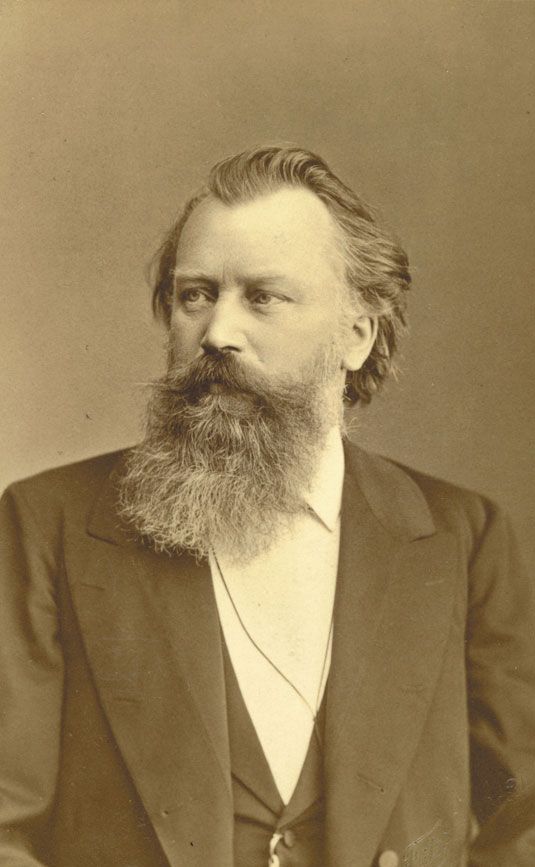
Johannes Brahms (1833-1897)
Academic Festival Overture, Op. 80
Composers, as a rule, do not enjoy being told what to write. So when the University of Breslau informed Johannes Brahms in 1879 that they were awarding him an honorary Doctorate of Philosophy, he was both honored and slightly vexed. The university statutes hinted broadly that he should express his gratitude in a musical form—a symphony, perhaps. The notoriously self-critical Brahms, however, had his own ideas. Rather than a stuffy, formal piece of academic music, he decided to have a bit of fun. The result was the Academic Festival Overture, a
...
Johannes Brahms (1833-1897)
Academic Festival Overture, Op. 80
Composers, as a rule, do not enjoy being told what to write. So when the University of Breslau informed Johannes Brahms in 1879 that they were awarding him an honorary Doctorate of Philosophy, he was both honored and slightly vexed. The university statutes hinted broadly that he should express his gratitude in a musical form—a symphony, perhaps. The notoriously self-critical Brahms, however, had his own ideas. Rather than a stuffy, formal piece of academic music, he decided to have a bit of fun. The result was the Academic Festival Overture, a work he cheekily described as a "very boisterous potpourri of student songs."
The university faculty, gathered for the premiere in January 1881 with Brahms himself on the podium, may have anticipated a solemn, dignified thank-you. Instead, they were greeted with a masterful and uproarious musical prank. Brahms, drawing on his own fond memories of student life filled with camaraderie and tavern revelry, selected four popular German student drinking songs and wove them into a sophisticated orchestral tapestry.
The overture begins not with a grand statement, but with a quiet, almost stealthy string melody, a hushed theme of Brahms’s own invention that builds anticipation. The first student song soon appears: "Wir hatten gebauet ein stattliches Haus" ("We have built a stately house"), a fraternity song played majestically by the trumpets. The mood shifts with the introduction of the second tune, "Der Landesvater" ("The Father of our Country"), a more solemn melody presented by the violins.
But Brahms quickly dispels any hint of seriousness. The atmosphere becomes increasingly boisterous with the arrival of the third song, "Was kommt dort von der Höh'?" ("What comes there from on high?"), a freshman hazing song. Here, Brahms unleashes the piccolo and bassoon in a comical, almost farcical duet, creating what is surely one of the most delightful musical jokes in the repertoire. It is easy to imagine the bewilderment and perhaps stifled laughter of the university dignitaries at hearing this rowdy tune echo through their hallowed halls.
For his grand finale, Brahms saves the most famous song of all: "Gaudeamus igitur" ("Therefore, let us rejoice"). This universally recognized student anthem, a call to live life to the fullest, erupts in the full orchestra, punctuated by crashing cymbals and booming bass drum. It is a moment of pure, unadulterated joy. By concluding with this hymn to youth and celebration, Brahms not only fulfilled his obligation to the university but did so entirely on his own terms, leaving behind a work that is both brilliantly crafted and irresistibly fun. It remains a sparkling testament to the composer’s wit and a reminder that even the most serious masters can have a playful side.