Your Request is under process, Please wait.

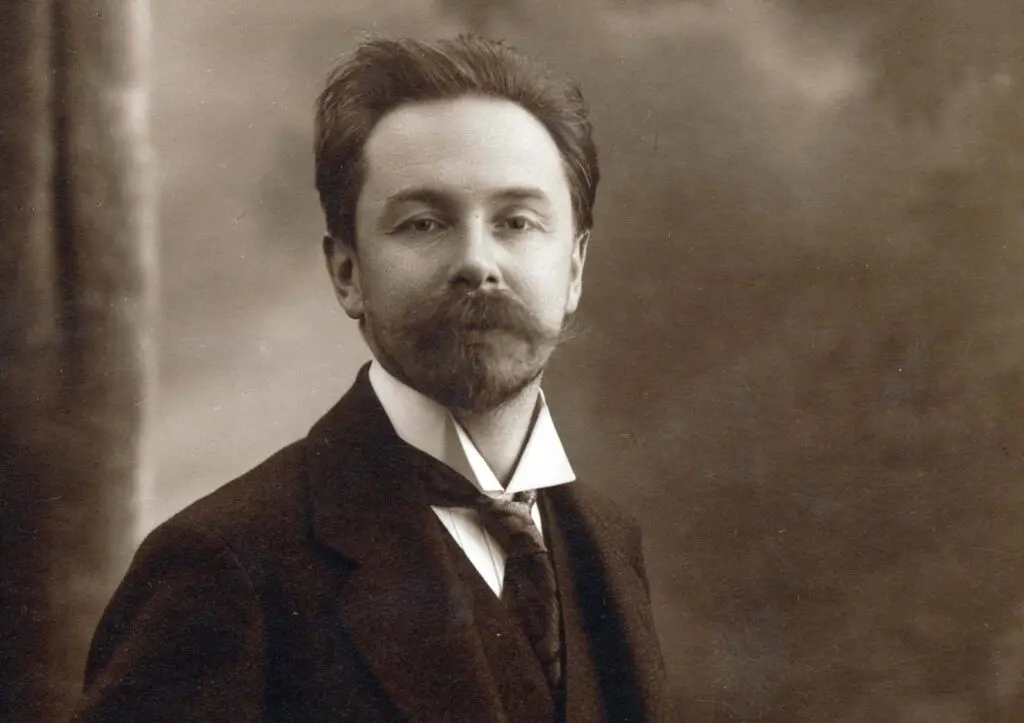
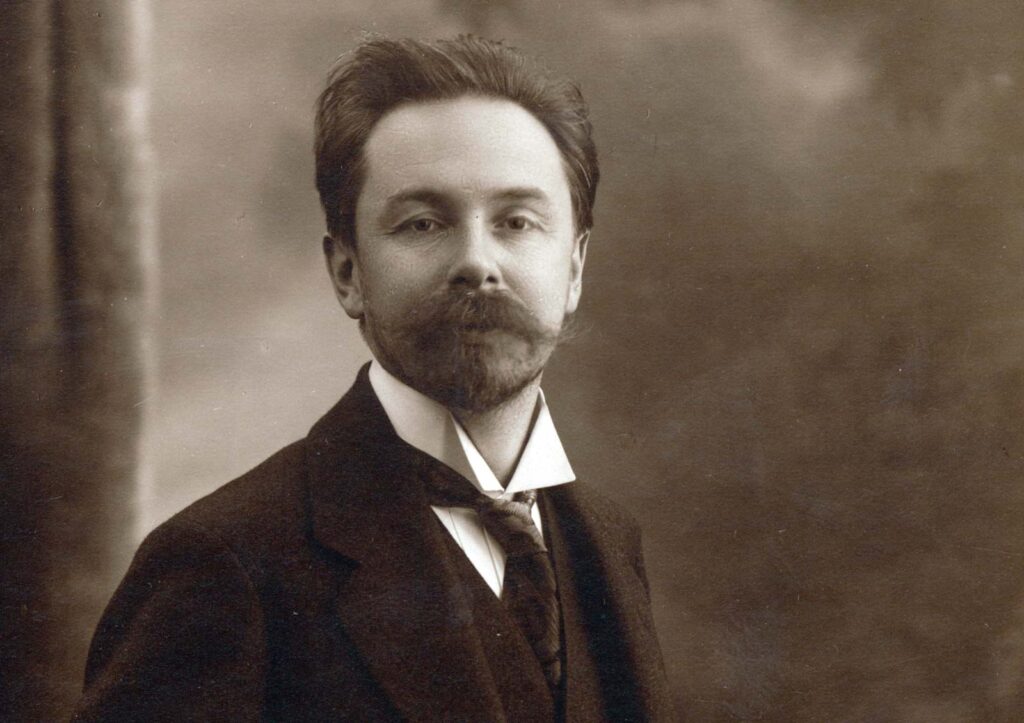
Alexander Scriabin (1871–1915)
Download free sheet music from Alexander Scriabin.
Alexander Scriabin remains one of the most enigmatic and visionary figures in the history of Western classical music. A Russian composer and virtuoso pianist, he began his career under the deep influence of Frédéric Chopin, crafting delicate mazurkas and nocturnes that shimmered with Romantic sensibility. However, his artistic trajectory was unlike any of his contemporaries. As he moved into the early 20th century, Scriabin’s harmonic language underwent a radical transformation, abandoning traditional tonality for a complex, dissonant system built on the "Mystic Chord." This evolution was fueled by his
...The Mystic Flame: Alexander Scriabin and the Alchemy of Sound
One of the most famous anecdotes involving Alexander Scriabin centers not on a grand concert hall, but on his obsession with a small, seemingly insignificant physical ailment that would eventually claim his life. Scriabin was a notorious hypochondriac, terrified of germs and constantly grooming himself with meticulous care. It is a tragic irony of music history that this man, who dreamed of a "Mysterium"—a week-long performance in the Himalayas involving thousands of participants, bells hanging from clouds, and scents filling the air to bring about the end of the world and the birth of a new race—died from a simple infection. A small boil on his lip, likely caused by a shaving accident or a minor scratch, turned into septicemia. As he lay dying, he reportedly looked at his hands, those legendary tools that had navigated the most complex piano literature ever written, and lamented the unfinished state of his cosmic work. This intersection of the mundane and the transcendental defines the Scriabin experience: a man with his feet barely touching the earth, yet brought down by its smallest biological realities.
Scriabin's early period is often characterized as a period of "Chopinesque" refinement. Studying at the Moscow Conservatory alongside Sergei Rachmaninoff, Scriabin was a star pupil of Vasily Safonov. While Rachmaninoff’s music stayed rooted in the lush, melancholic soil of Russian Romanticism, Scriabin’s early works, such as the 24 Preludes, Op. 11, showed a restless harmonic curiosity. These pieces are masterpieces of brevity, capturing fleeting moods with a delicacy that rivaled Frédéric Chopin himself. Yet, even here, one can hear the seeds of his later style—the nervous rhythms, the wide-spanning intervals, and an almost frantic energy that pushed against the boundaries of 19th-century form. During this time, he was supported by the wealthy publisher Mitrofan Belyayev, who recognized the young man's genius and helped facilitate his tours across Europe.
As the 19th century turned into the 20th, Scriabin’s philosophy shifted. He became deeply immersed in the writings of Helena Blavatsky, the founder of Theosophy. He began to view himself not merely as a composer, but as a messianic figure whose music could induce a collective spiritual ecstasy. This shift is most evident in his middle-period piano sonatas. The Sonata No. 4 in F-sharp major marks the beginning of this transition, where the music seems to strive upward toward a "flight" into the sun. The final movement, marked Prestissimo volando, is a tour de force of speed and lightness, representing the soul’s liberation from the gravity of the material world.
By the time he composed his Symphony No. 3, known as The Divine Poem, Scriabin was operating on a massive scale. The work is divided into three sections: "Struggles," "Pleasures," and "Divine Play." It represents the human spirit's liberation from the shackles of a personal God and its realization of its own divinity. The influence of Richard Wagner is evident in the chromaticism and the use of leitmotifs, but the shimmering, ecstatic textures are purely Scriabin’s own. He was no longer interested in traditional developmental logic; instead, he wanted to create a "state" of being, a sonic environment that enveloped the listener.
The pinnacle of his orchestral output, and perhaps his most famous work, is Le Poème de l'extase (The Poem of Ecstasy). Completed in 1908, it is a single-movement symphonic poem that explores the relationship between creative spirit and erotic desire. The work is famous for its soaring trumpet solos and its massive, earth-shaking climaxes. It was during the composition of this work that Scriabin began to fully integrate his theories of synesthesia. He perceived the key of C major as red, F-sharp major as bright blue or violet, and D major as golden-yellow. This was not just a metaphor for him; it was a physical reality. To Scriabin, the movement of harmonies was a movement through a spectrum of light.
This fascination with light culminated in Prometheus: The Poem of Fire. For this work, Scriabin included a part for a clavier à lumières or "color organ." This instrument was designed to project colors onto a screen in synchronization with the musical harmonies. The score includes a staff labeled "Luce," which dictates the changing hues of the performance space. Harmonically, Prometheus is built entirely upon the "Mystic Chord"—a hexachord consisting of the notes C, F-sharp, B-flat, E, A, and D. By stacking fourths (augmented, diminished, and perfect), Scriabin created a sound that felt suspended in space, neither major nor minor, providing a sense of eternal hovering that perfectly suited his mystical themes.
Scriabin's final five piano sonatas (Nos. 6 through 10) are among the most radical works of the early 20th century, predating the innovations of Arnold Schoenberg and Igor Stravinsky. The Sonata No. 6 was so dark and "nightmarish" that Scriabin himself was afraid to play it in public, claiming it was "contaminated" by demonic forces. In contrast, the Sonata No. 7, subtitled "The White Mass," was intended as an exorcism of that darkness, filled with crystalline trills and ecstatic fanfares. The Sonata No. 9, known as "The Black Mass," returns to the shadows, featuring a creeping, sinister theme that eventually explodes into a grim, percussive march. Finally, the Sonata No. 10, the "Insects Sonata," is filled with trills and tremolos that mimic the shimmering of wings and the vibration of the atmosphere, representing the final dissolution of form into pure light.
The impact of Scriabin’s work on later generations cannot be overstated. His exploration of non-traditional scales and his belief in the synthesis of the senses influenced the Alexander Nikolayevich Scriabin circle in Russia, including composers like Nikolai Roslavets. Even after the Soviet government initially cooled toward his "mystical individualism," his music remained a vital underground influence for composers like Olivier Messiaen, who shared Scriabin’s fascination with the theological and the synesthetic. Performing Scriabin requires a specific type of virtuosity—one that manages both the technical "acrobatics" of the Russian school and a hypersensitive control of tone color and pedaling. As the pianist Vladimir Horowitz (who met Scriabin as a child) famously demonstrated, Scriabin’s music demands a "feverish" intensity that can leave both performer and audience breathless.
In the modern concert hall, a program note for Scriabin should emphasize the transformative nature of the music. It is not passive listening; it is an invitation to an experience. Whether through the "perfumed" harmonies of his early works or the "incandescent" eruptions of his late period, Scriabin challenges the listener to abandon the safety of the familiar and leap into the unknown. Downloading his sheet music offers a direct path into the mind of a man who believed that a single chord could change the world. As one navigates the shifting rhythms and kaleidoscopic harmonies of a Scriabin score, they are engaging with a legacy that remains as vibrant and provocative today as it was a century ago. His music does not just sit on the page; it vibrates with a restless, cosmic energy, waiting for the next performer to set it ablaze.
Ultimately, Alexander Scriabin stands as a bridge between two worlds: the fading elegance of the 19th-century salon and the fractured, neon-lit landscape of the 20th-century avant-garde. He was a composer who sought to turn sound into light, and light into spirit. While his "Mysterium" remained unperformed, every time a pianist strikes the final, shimmering chord of a Scriabin sonata, a small part of that cosmic dream is realized. The flame he lit continues to burn, inviting us all to participate in the ecstasy of creation.
Bowers, Faubion. Scriabin: A Biography. Dover Publications, 1996.
MacDonald, Hugh. Skryabin. Oxford University Press, 1978.
Ballard, Lincoln and Matthew Bengtson. The Alexander Scriabin Companion: History, Performance, and Lore. Rowman & Littlefield, 2017.
Nicholls, Simon. The Keyboard Music of Alexander Scriabin. Cambridge University Press, 2018.
Sabaneev, Leonid. Modern Russian Composers. International Publishers, 1927.

Follow us : 


Sheet Music International - Copyright 2025 all rights reserved
| English: Sheet Music (PDF) | Free Scores | Français: Partitions (PDF) | Musique gratuite | Ελληνικά: Παρτιτούρες (PDF) | Δωρεάν μουσική |
| Deutsch: Noten (PDF) | Kostenlose Partituren | Español: Partituras (PDF) | Música impresa | Português: Partituras (PDF) | Música gratuita |
| Italiano: Spartiti (PDF) | Partiture musicali | Русский: Ноты (PDF) | Бесплатные партитуры | Norsk: Noter (PDF) | Gratis noter |
| Українська: Ноти (PDF) | Безкоштовні партитури | Polski: Nuty (PDF) | Darmowe nuty | Nederlands: Bladmuziek (PDF) | Gratis partituren |