Your Request is under process, Please wait.

Wolfgang Amadeus Mozart’s Horn Concerto fragment in E-flat major, K. 370b, represents one of the most fascinating and tantalizing puzzles in the classical wind repertoire. Composed in Vienna during the early months of 1781, this incomplete draft marks the exact moment where the twenty-five-year-old master transitioned away from his suffocating employment in Salzburg to establish his independence as a freelance artist in the imperial capital.
The work was explicitly conceived for his lifelong childhood friend, the celebrated horn virtuoso Joseph Leutgeb, whose extraordinary technical abilities on the valveless natural horn inspired all of Mozart's subsequent
...The Viennese Awakening: Musicological Reconstruction and Natural Horn Artistry in the K. 370b Fragment
The Genesis of the Leutgeb Collaboration
The early months of 1781 represented a period of immense personal upheaval and creative liberation for Mozart, who had traveled to Vienna in the retinue of his hated employer, Archbishop Colloredo. Determined to break free from his provincial duties, the young master reconnected with Joseph Leutgeb, a former Salzburg court horn player who had recently relocated to Vienna to operate a small, humble cheese shop funded by a loan from Mozart's own father, Leopold Mozart. Despite Leutgeb's modest secondary profession, he was universally recognized as one of the finest natural horn virtuosos in Europe, possessing an uncanny ability to produce a flawless, singing tone from an instrument that lacked any keys or mechanical valves.
The Noble Stature of the Reconstructed Exposition
The movement carries an unwritten but universally accepted tempo framework of Allegro, a key signature pacing that matches the proud, hunting-horn characteristics historically associated with the key of E-flat major. The orchestral exposition opens with a broad, stately primary theme that radiates imperial confidence, driven forward by a clean, motoric pulse in the strings and bright, open chord accentuations from the two ripieno horns and oboes.
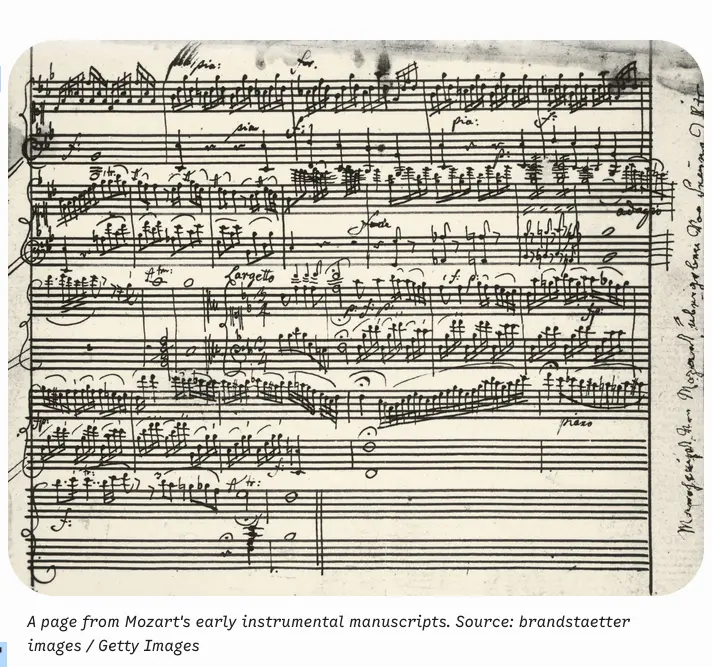
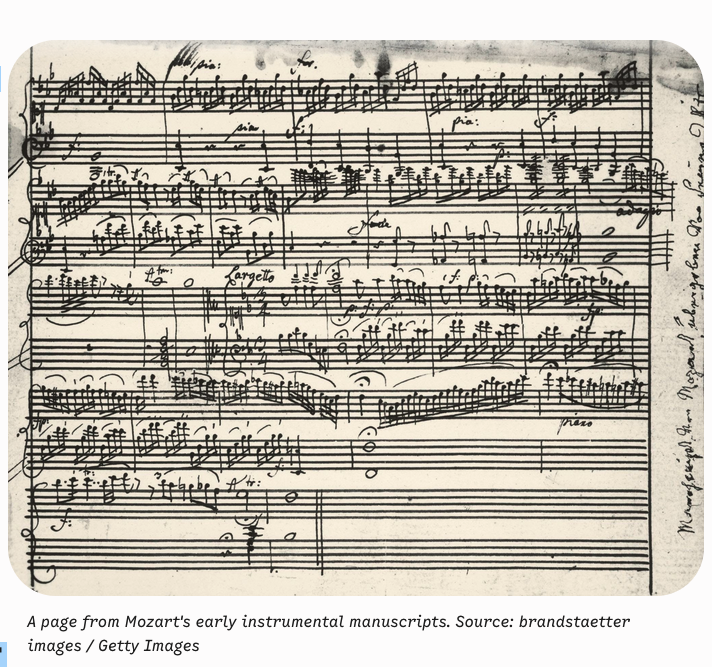
This introductory layout perfectly mirrors the formal symphonic structures popularized by Franz Joseph Haydn, establishing a firm, highly stable tonal center before the entry of the primary wind soloist. Because Mozart left large swaths of the orchestral string parts completely blank in the center of the manuscript, modern reconstructive editors have had to carefully flesh out the underlying harmonies by drawing direct stylistic connections to his completed works from the exact same period, such as the grand Serenade for Winds, K. 361. This pristine textures ensure that the overall musical architecture avoids the heavy, dense contrapuntal weaving associated with earlier Baroque masters like Johann Sebastian Bach, preserving a clean, transparent canvas where every note feels purposeful.
Solo Artistry and Hand-Stopping Subversion
When the solo horn finally makes its grand entrance, it completely dominates the ensemble by delivering a soaring, elongated statement that forces the orchestra into a supportive, conversational role. The solo part is an extraordinary testament to the natural horn's historical capabilities, requiring the performer to navigate rapid scale passages and wide interval leaps that would trip up modern players utilizing fully valved instruments. To produce the chromatic notes required by Mozart's developing themes, Leutgeb had to adjust his right hand inside the instrument's bell to alter the pitch, a technique that drastically changed the acoustic color of the horn from a bright, brassy ring to a covered, muffled whisper. Instead of viewing this physical limitation as a flaw, Mozart brilliantly utilized these shifting tonal colors to create a highly theatrical, conversational dialogue, passing small motivic fragments back and forth between the solo horn and the orchestral first violins. The development section, though brief and heavily reliant on modern musicological reconstruction, moves rapidly through an array of closely related keys, casting brief, dramatic shadows across the landscape before steering the music back to the home key for a triumphant classical recapitulation.
The Detective Story of Musicological Reintegration
What makes K. 370b uniquely compelling to modern listeners is the absolute nightmare of its physical preservation history, an structural trauma that highlights the profound value of modern academic recovery efforts. Following the composer's untimely death, his widow Constanze sold portions of his unfinished manuscripts, and over the course of the nineteenth century, the autograph score of K. 370b was literally cut up with scissors so that tiny squares of Mozart's handwriting could be sold as expensive souvenirs to wealthy European collectors.
This senseless destruction left the movement completely fractured, with individual measures scattered across museums and private libraries in Paris, Berlin, and various locations in Poland. In the late twentieth and early twenty-first centuries, researchers meticulously tracked down these missing fragments, using advanced ink analysis and paper-watermark dating to digitally reassemble the jigsaw puzzle. Furthermore, musicologists discovered that a completely separate rondo movement, K. 371, was intended to serve as the companion finale to this specific Allegro, allowing modern ensembles to perform a complete, two-movement concert experience that had been lost for over two centuries.
Contrapuntal Integrity and the Enduring Legacy of K. 370b
Beneath the sparkling, lighthearted surface of this reconstructed piece lies a robust framework of classical counterpoint that prevents the music from sounding like a superficial technical exercise. The orchestral strings do not merely provide static harmonic padding; instead, the cellos and violas routinely engage in imitative, conversational responses to the soloist's sweeping lines, displaying the strict contrapuntal logic that Mozart had perfected during his intense childhood studies of Johann Sebastian Bach and his encounters with Padre Martini in Italy. This underlying intellectual discipline gives the unfinished fragment an extraordinary sense of poise, balance, and formal integrity. Rather than concluding with a massive, dramatic explosion of symphonic volume, the movement draws to a close with a characteristic classical understatement, as the solo horn executes a final, brilliant fanfare before the orchestra wraps up the architecture with a pair of brief, polite chords. Through its incredible combination of personal defiance, instrumental innovation, and miraculous musicological survival, the K. 370b fragment remains an indispensable masterpiece that permanently illuminated the path toward the golden era of classical wind literature.

Follow us : 


Sheet Music International - Copyright 2025 all rights reserved
| English: Sheet Music (PDF) | Free Scores | Français: Partitions (PDF) | Musique gratuite | Ελληνικά: Παρτιτούρες (PDF) | Δωρεάν μουσική |
| Deutsch: Noten (PDF) | Kostenlose Partituren | Español: Partituras (PDF) | Música impresa | Português: Partituras (PDF) | Música gratuita |
| Italiano: Spartiti (PDF) | Partiture musicali | Русский: Ноты (PDF) | Бесплатные партитуры | Norsk: Noter (PDF) | Gratis noter |
| Українська: Ноти (PDF) | Безкоштовні партитури | Polski: Nuty (PDF) | Darmowe nuty | Nederlands: Bladmuziek (PDF) | Gratis partituren |