Your Request is under process, Please wait.

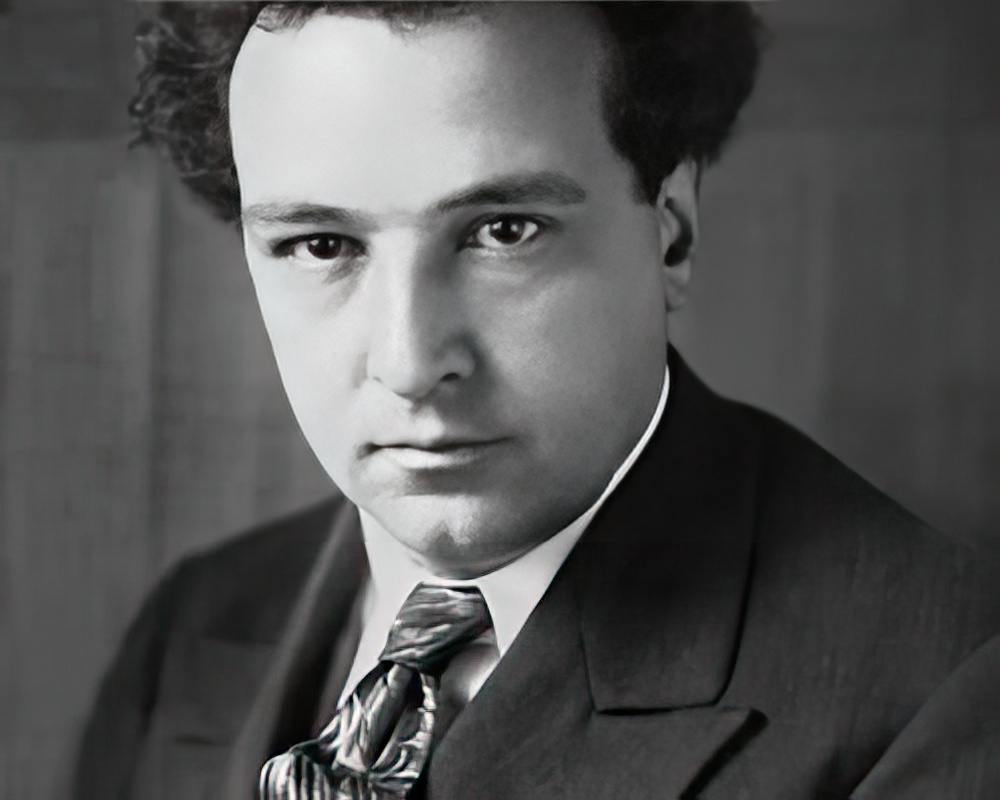
Arthur Honegger (1892-1955)
Download free sheet music from Arthur Honegger.
Experience the powerful and dramatic music of Arthur Honegger, a leading Swiss-French composer of the 20th century. A prominent member of the influential group Les Six, Honegger forged a unique and independent voice, blending the weighty contrapuntal traditions of German music with the clarity and color of the French school. From the raw, mechanical energy of his orchestral masterpiece Pacific 231 to the monumental drama of his oratorio Le Roi David, his work is celebrated for its expert craftsmanship and profound emotional depth. Our library offers a selection
...The Architect of Sound and Steam
The audience at the Paris Opéra on May 8, 1924, was not prepared for what they were about to hear. The conductor, Serge Koussevitzky, raised his baton, and the orchestra unleashed a sound unlike any before it: the slow, grinding hiss of steam, the percussive clang of metal, the rhythmic churning of giant wheels slowly gaining momentum. Over the course of six minutes, the music built into a thunderous, terrifying crescendo of raw power, finally reaching a triumphant speed before a sudden, screeching halt. The piece was Pacific 231, and its composer, Arthur Honegger, had not just written a piece of music; he had built a massive steam locomotive out of brass, strings, and woodwinds. The work's premiere caused a sensation, cementing Honegger's reputation as a daring modernist and a master architect of sound.
Swiss Roots, Parisian Spirit
Although he would become a defining figure of French music, Arthur Honegger was a Swiss citizen his entire life. He was born in the French port city of Le Havre on March 10, 1892, to Swiss parents. His father was a coffee importer, and his upbringing was steeped in the disciplined, Protestant values of his Swiss-German heritage. His musical training began early, first in Le Havre and then at the Zurich Conservatory. This dual background was the key to his artistic identity: he possessed a deep reverence for the German masters, especially Johann Sebastian Bach, with his formidable logic and contrapuntal genius.
In 1911, he moved to the epicenter of the artistic world: Paris. At the Paris Conservatoire, he studied with leading figures like the organist Charles-Marie Widor and the composer Vincent d'Indy. Here, he absorbed the French traditions of elegance, vibrant instrumental color, and clarity of form. This fusion of German structure and French sonority would become the hallmark of his style, setting him apart from his contemporaries.
Les Six: A Rebellious Alliance
In post-World War I Paris, a rebellious spirit swept through the arts. A group of young composers, weary of the lush romanticism of Wagner and the "hazy" impressionism of Debussy, began to gather around the iconoclastic figures of Erik Satie and Jean Cocteau. In 1920, the critic Henri Collet famously grouped six of them together under the label Les Six. Alongside Honegger were Francis Poulenc, Darius Milhaud, Georges Auric, Louis Durey, and Germaine Tailleferre. Their shared goal was to create a new kind of French music—direct, unsentimental, and inspired by everyday life, from the circus and the music hall to the sounds of the city.
Honegger was always the odd man out in the group. While he shared their desire for a move away from Impressionism, he had little interest in the ironic, sometimes frivolous aesthetic championed by Cocteau and Satie. He famously declared, "I do not cultivate music of the fairground." He was, at heart, a traditionalist, a composer of symphonies and oratorios in an age of anti-romantic sentiment. He remained on friendly terms with the others but ultimately forged his own, more serious path.
The Roar of the Machine Age
Honegger's fame exploded with his trilogy of orchestral works known as "Mouvements symphoniques." The first and most famous, Pacific 231 (1923), was a groundbreaking piece of musical realism. Honegger described it not as an imitation of sounds, but as a translation of the "visual impression and physical sensation" of a powerful locomotive. He constructed the piece as a great, dynamic crescendo, translating the mechanics of the machine into a tightly controlled musical structure.
He followed this with Rugby (1928), which captures the violent, chaotic energy and rhythmic drive of the sport, and Mouvement symphonique No. 3 (1933), a more abstract but equally powerful and motoric work. These pieces made him a figurehead of the "machine age," a composer who found a dark, thrilling beauty in the technology and dynamism of the modern world.
Oratorios and the Sacred Stage
Parallel to his fascination with modern subjects was a deep engagement with sacred and dramatic themes. In 1921, he was commissioned to write incidental music for a play, and the result was the work that truly established his international reputation: Le Roi David (King David). He later re-orchestrated it as a massive "dramatic psalm," or oratorio. The work was a revelation. Its style was eclectic and powerful, combining barbaric, driving rhythms reminiscent of Igor Stravinsky with moments of tender lyricism, Baroque-style counterpoint, and a unifying narration. It was a raw, theatrical, and deeply felt work that redefined the modern oratorio.
He followed this success with other large-scale dramatic vocal works, most notably Jeanne d'Arc au bûcher (Joan of Arc at the Stake, 1935). With a libretto by the poet Paul Claudel, this masterpiece is a unique blend of opera and oratorio, telling the story of Joan of Arc's final moments through a series of flashbacks. It is one of the most powerful and moving theatrical works of the 20th century.
The War Years and the Symphony of Resistance
When Germany invaded France in 1940, many artists fled. Honegger, a Swiss neutral, chose to remain in Paris throughout the occupation. He continued to compose and worked as a music critic, and was quietly active in the French Resistance. The dark years of the war profoundly impacted his music, leading to the creation of his most celebrated symphony.
The Symphony No. 2 for string orchestra and trumpet ad libitum was completed in 1941. It is a grim, intense, and deeply moving work. For three movements, the strings weave a dense, tragic tapestry of sound. Then, in the final moments of the finale, a lone trumpet enters, soaring above the strings with a radiant chorale melody based on a theme from Bach. For audiences in occupied Paris, the meaning was unmistakable: it was a symbol of defiance, hope, and the ultimate triumph of the human spirit over tyranny. He would go on to write three more symphonies, with the powerful Symphony No. 3, subtitled Symphonie Liturgique with its movements titled after the Requiem Mass, standing as another profound response to the devastation of war.
A Legacy of Structure and Soul
Arthur Honegger's health declined after the war, and he died in his beloved Paris in 1955. He left behind a body of work marked by its extraordinary craftsmanship and emotional honesty. He was an architect in music, building powerful, logical structures capable of containing immense feeling. He bridged the gap between the French and German traditions, between modernism and a deep reverence for the past, and between the noise of the machine and the cry of the human soul. He remains one of the most important and enduring voices of 20th-century music.
Halbreich, Harry. Arthur Honegger. Translated by Roger Nichols. Portland, OR: Amadeus Press, 1999.
Spratt, Geoffrey K. The Music of Arthur Honegger. Cork: Cork University Press, 1987.
Honegger, Arthur. I Am a Composer. Translated by Wilson O. Clough. London: Faber and Faber, 1966.
Kelly, Barbara L. Music and Ultra-Modernism in France: A Fragile Consensus, 1913-1939. Woodbridge, Suffolk, UK: Boydell Press, 2013.
Follow us : 


Sheet Music International - Copyright 2026 all rights reserved
| English: Sheet Music (PDF) | Free Scores | French: Sheet Music (PDF) | Free Scores | Greek: Sheet Music (PDF) | Free Scores |
| German: Sheet Music (PDF) | Free Scores | Spanish: Sheet Music (PDF) | Free Scores | Portuguese: Sheet Music (PDF) | Free Scores |
| Italian: Sheet Music (PDF) | Free Scores | Russian: Sheet Music (PDF) | Free Scores | Norwegian: Sheet Music (PDF) | Free Scores |
| Ukrainian: Sheet Music (PDF) | Free Scores | Polish: Sheet Music (PDF) | Free Scores | Dutch: Sheet Music (PDF) | Free Scores |