Your Request is under process, Please wait.

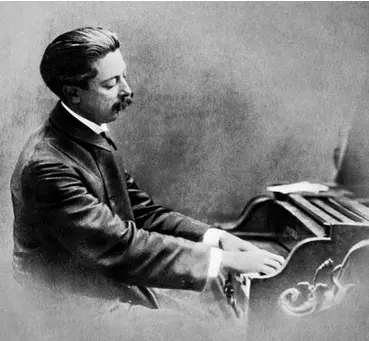
nrique Granados (1867-1916)
Download free sheet music from Enrique Granados.
Experience the romantic soul of Spain through the music of Enrique Granados, the great "poet of the piano." His compositions are a tribute to the elegance and passion of a bygone era, famously inspired by the artwork of Francisco Goya. Granados combined the improvisatory flair of Spanish folk music with the refined romanticism of Chopin, creating a unique and deeply expressive voice. Now, you can perform these masterful works yourself. We offer a curated collection of his most beloved pieces, including the passionate Goyescas and the charming Danzas españolas,
...Detailed Biography
The Poet of the Piano: Goya's World in the Music of Enrique Granados
On March 24, 1916, the civilian steamship Sussex was crossing the English Channel when, without warning, it was struck by a torpedo from a German U-boat. Among the passengers thrown into the churning, icy water was the great Spanish composer Enrique Granados. After being pulled into a lifeboat, he saw his wife, Amparo, struggling in the waves. Despite a lifelong, crippling fear of water, he dove back in to save her. They were pulled under by the current and drowned, locked in an embrace. This final, tragic act of love and impulse was a devastating end to the life of one of Spain's most important composers—a man whose music was the very embodiment of the passionate, romantic spirit that defined his final moments.
A Catalan Prodigy
Pantaleón Enrique Joaquín Granados Campiña was born in Lleida, Catalonia, in 1867. His father was an army officer, and the family moved to Barcelona when Enrique was a child. He showed prodigious musical talent early on and began studying piano with Joan Baptista Pujol, whose other students would include Isaac Albéniz. His most influential teacher, however, was the composer and musicologist Felipe Pedrell. Known as the father of Spanish musical nationalism, Pedrell instilled in both Granados and Albéniz the importance of looking to Spain’s own rich folk traditions for inspiration. While Albéniz would later focus on the fiery folk music of Andalusia, Granados was drawn to the more aristocratic and Castilian elements of Spanish culture.
The Paris Connection
In 1887, Granados moved to Paris, the artistic capital of Europe, to complete his studies. Though he was too late to enroll formally at the Conservatoire, he took private lessons with Charles-Wilfrid de Bériot, a professor at the school whose mother had been a student of Frédéric Chopin. This connection was formative. Granados developed a deep affinity for Chopin's romanticism, with its lyrical melodies, rich harmonies, and nuanced expressiveness. He also absorbed the elegant atmosphere of the Parisian salons, befriending composers like Camille Saint-Saëns, Gabriel Fauré, and Vincent d'Indy. This Parisian polish, combined with his innate Spanish sensibility, would become the hallmark of his unique musical style.
The Poet of the Piano
Upon returning to Barcelona in 1889, Granados established himself as a brilliant concert pianist and a respected teacher, founding his own piano school, the Academia Granados, in 1901. It was during this period that he composed the works that first brought him international fame. His Danzas españolas (Spanish Dances), a set of twelve pieces for piano, were an immediate success. The composer Jules Massenet wrote that he considered Granados "the Spanish Grieg." These pieces were not literal transcriptions of folk dances but rather idealized, romantic evocations of Spanish rhythms and melodies, filled with charm, grace, and melancholy.
Unlike the extroverted virtuosity of his friend Isaac Albéniz, Granados's music was more intimate and poetic. His piano writing often features improvisatory-sounding flourishes, rich ornamentation, and a deep, sonorous tone, earning him the nickname "the poet of the piano." His style was less concerned with raw folkloric authenticity and more with capturing a romanticized, almost nostalgic vision of Spain. It was a vision deeply influenced not by contemporary life, but by the art of a painter who had died nearly a century earlier.
Goyescas: An Obsession in Sound
Granados was utterly captivated by the world of the 18th-century Spanish painter Francisco Goya. He was drawn to the vibrant, romantic, and often dramatic scenes of aristocratic life in Madrid, populated by elegant ladies (majas) and dashing gentlemen (majos). He once declared, "I am in love with the psychology of Goya, with his palette, with him, with his muse the Duchess of Alba." This obsession culminated in his masterpiece, the piano suite Goyescas, subtitled Los majos enamorados (The Gallants in Love), composed between 1909 and 1911.
The suite is one of the summits of the piano repertoire. It is a work of immense difficulty and profound musical depth, translating Goya's visual world into sound. The pieces are not direct depictions of specific paintings but rather fantasies inspired by their atmosphere. The most famous movement, "Quejas, o La Maja y el ruiseñor" (The Maiden and the Nightingale), is a stunningly beautiful nocturne, a lament of love and loss where the piano imitates the song of a nightingale in passages of breathtaking virtuosity and poetry. The music of Goyescas is a world away from the sun-drenched folklorism of Albéniz's Iberia; it is nocturnal, aristocratic, and steeped in the romanticism of Chopin and Schumann, yet unmistakably Spanish in its soul.
Triumph and Tragedy
The success of the Goyescas piano suite was so great that Granados was encouraged to expand it into an opera. The premiere was scheduled for Paris, but the outbreak of World War I forced a change of plans. Instead, the opera Goyescas had its triumphant world premiere at the Metropolitan Opera in New York City on January 28, 1916. It was the first Spanish-language opera to be presented there and was a great success. Granados, who had a morbid fear of the ocean, had been reluctant to make the journey, but he and his wife Amparo traveled to America and were celebrated by the public and critics alike.
Following the premiere, he was invited by President Woodrow Wilson to perform a piano recital at the White House. This prestigious engagement caused him to miss his booking on a direct ship back to Spain. To return home, the couple had to take a ship to England first. They boarded the passenger ferry Sussex at Folkestone, bound for Dieppe, France. It was on this final, fateful leg of their journey that the German U-boat UB-29 torpedoed their ship, leading to their tragic deaths. The world lost not only a great composer but a brilliant pianist whose own interpretations of his works were said to be unparalleled. His legacy is that of a quintessential Spanish romantic, a musician who, through the filter of his own poetic soul, transformed the world of Goya into unforgettable sound.
Clark, Walter Aaron. Enrique Granados: Poet of the Piano. Oxford University Press, 2006.
Chase, Gilbert. The Music of Spain. Dover Publications, 1959.
Hess, Carol A. Enrique Granados: A Bio-Bibliography. Greenwood Press, 1991.
Riva, Douglas. The Larrocha Legacy, Vol. I: The Albéniz-Granados-Falla Connection. Backbeat Books, 2017.
Clark, Walter Aaron. "Granados, Enrique." Grove Music Online. Oxford University Press, 2001.

Follow us : 


Sheet Music International - Copyright 2026 all rights reserved
| English: Sheet Music (PDF) | Free Scores | French: Sheet Music (PDF) | Free Scores | Greek: Sheet Music (PDF) | Free Scores |
| German: Sheet Music (PDF) | Free Scores | Spanish: Sheet Music (PDF) | Free Scores | Portuguese: Sheet Music (PDF) | Free Scores |
| Italian: Sheet Music (PDF) | Free Scores | Russian: Sheet Music (PDF) | Free Scores | Norwegian: Sheet Music (PDF) | Free Scores |
| Ukrainian: Sheet Music (PDF) | Free Scores | Polish: Sheet Music (PDF) | Free Scores | Dutch: Sheet Music (PDF) | Free Scores |