Your Request is under process, Please wait.

Crowned with the unofficial but fitting nickname "Emperor," Beethoven’s Fifth Piano Concerto is a monumental work of majestic power and heroic grandeur. Composed in 1809, during the Napoleonic siege of Vienna, it is the culmination of the composer’s "heroic" style and his final, definitive statement in the genre. The concerto announces its epic scale from the very first bars, with a series of brilliant, improvisatory flourishes for the piano that punctuate three powerful orchestral chords—a revolutionary opening that immediately establishes the soloist as a commanding presence. This is not a polite dialogue between piano and orchestra, but a true
...
 Composed in 1809 during Napoleon's bombardment and siege of Vienna, its imperial nickname was coined by English publisher Johann Baptist Cramer rather than the composer; due to worsening deafness, Beethoven could not perform the solo part, leaving the Leipzig premiere on November 28, 1811, to soloist Friedrich Schneider.
The Apotheosis of the Heroic Concerto
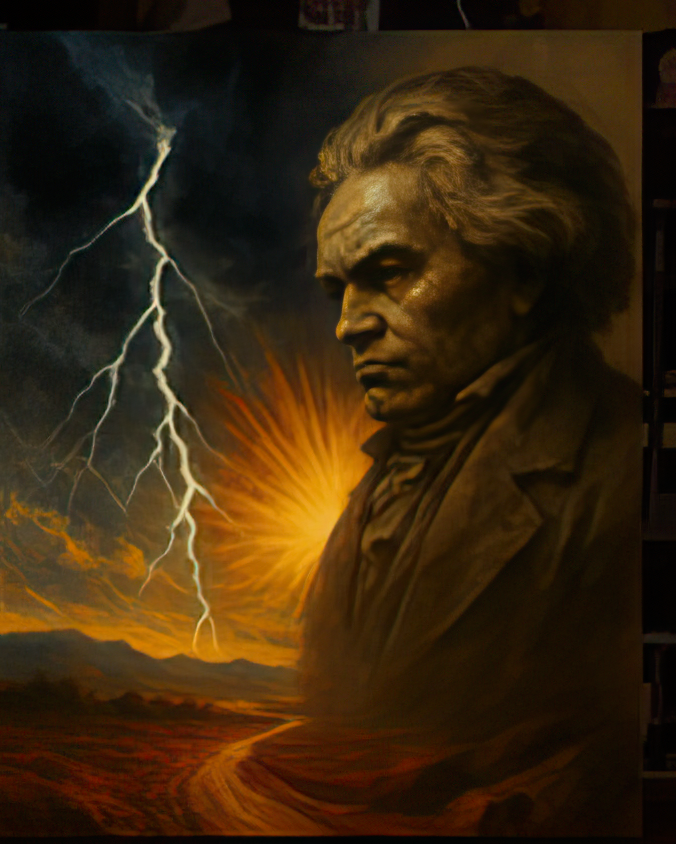
In May of 1809, as Napoleon's armies besieged and bombarded Vienna, Ludwig van Beethoven took refuge in the cellar of his brother's house. His hearing, already failing, was tortured by the roar of the cannons. He covered his head with pillows in a desperate attempt to protect what little he had left. It was in this crucible of war, chaos, and personal suffering that Beethoven forged his Fifth Piano Concerto, a work of magnificent, defiant, and triumphant heroism. The stark contrast between the squalid conditions of its creation and the majestic splendor of the music itself is a testament to the composer's incredible resilience. The concerto, later nicknamed the "Emperor," is a monumental act of artistic will, a defiant roar of the human spirit against the tumult of the world.
A Concerto Forged in Fire The choice of E-flat major, the same key as the "Eroica" Symphony, immediately signals the concerto's heroic intentions. The nickname "Emperor," likely bestowed by the English publisher Johann Baptist Cramer, is fitting for the music's imperial scale, though it is also ironic. By 1809, Beethoven had long since lost his admiration for Napoleon, the man he had once intended to honor with the "Eroica. " This concerto is not a tribute to any single ruler, but an expression of the sovereign power of the human spirit.
Movement I: Allegro – A Grand Imperial Entrance The concerto begins with one of the most dramatic and revolutionary openings ever conceived. A powerful E-flat major chord from the full orchestra is immediately answered by a grand, improvisatory cadenza from the piano. This powerful exchange is repeated twice more, firmly establishing the piano not as a petitioner waiting for its turn, but as a commanding, heroic protagonist from the very first bar. After this extraordinary introduction, the orchestra presents the themes of the massive sonata-form movement, which are noble, confident, and distinctly martial in character. The piano part is woven into the very fabric of the symphonic argument, its brilliant virtuosity serving the music's architectural grandeur. In a final act of authorial control, Beethoven explicitly forbids an improvised cadenza, writing in the score, "Do not play a cadenza, but go straight to the following," and provides his own written-out passage that leads directly into the coda.
Movement II: Adagio un poco mosso – A Nocturnal Hymn Following the epic scale of the Allegro, the slow movement is a sublime sanctuary of peace. In the remote and serene key of B major, it unfolds like a prayer. The muted strings introduce a beautiful, hymn-like theme of profound tranquility. The piano enters with a simple, almost improvisatory, and deeply expressive response, floating over the orchestra in a state of quiet contemplation. The mood is one of nocturnal stillness and spiritual reflection, a moment of profound, personal introspection that provides a perfect emotional counterbalance to the public splendor of the outer movements.
From Contemplation to Celebration: The Attacca Transition As the final chords of the Adagio fade into silence, Beethoven creates a moment of pure musical magic. The horns hold a soft, sustained note while the piano quietly re-enters, tentatively sketching a new theme—the theme of the finale. The harmony shifts mysteriously, descending step by step, creating an almost unbearable sense of anticipation. Then, without a pause (attacca), the piano launches the orchestra into the explosive final movement, seamlessly connecting the world of sacred contemplation to that of earthly, physical joy.
Movement III: Rondo: Allegro ma non troppo – A Dance of Unrestrained Joy The finale is a massive and exuberant sonata-rondo, unleashed by the piano with a vigorous, galloping main theme. This is music of unrestrained, triumphant energy, a dance of pure celebration. The theme, with its distinctive syncopated rhythm, is both powerful and playful, and it drives the movement forward with irresistible momentum. The interplay between the piano and orchestra is brilliant and exhilarating, a true partnership in joy. In one of the most imaginative moments in the coda, the orchestra falls silent, leaving the piano to have a quiet, suspenseful dialogue with the timpani before the full ensemble erupts one last time to bring the concerto to a thunderous and glorious conclusion.
A Symphony for Piano and Orchestra The "Emperor" represents the culmination of Beethoven's re-imagining of the concerto form. It is no longer a showpiece for a soloist with orchestral accompaniment; it is a true symphony for piano and orchestra. By eliminating the improvised cadenza and weaving the piano part so inextricably into the symphonic texture, Beethoven created a new model of concerto writing. The soloist and the orchestra are equal partners, two powerful forces united in a single, grand, and cohesive dramatic statement.
The Composer Who Could Not Perform This grandest of concertos is also the only one that Beethoven never performed in public. His deafness was so advanced by the time of its premiere in Leipzig in 1811 that the role of soloist had to be entrusted to the pianist Friedrich Schneider. The Vienna premiere a year later was performed by Beethoven’s student Carl Czerny. This marked the sad end of Beethoven’s career as a public pianist. The "Emperor" is thus a monument to his extraordinary inner ear and his ability to imagine and create sounds of such splendor that he himself would never get to hear.
The Archetype of the Romantic Concerto The "Emperor" Concerto became the undisputed archetype for the grand heroic concerto of the 19th century. Its massive scale, powerful virtuosity, and the symphonic integration of the solo part set the standard for generations of composers to come. The concertos of Robert Schumann, Johannes Brahms, Pyotr Ilyich Tchaikovsky, and Sergei Rachmaninoff are all, in their own way, descendants of the "Emperor. " It is the fountainhead from which the great Romantic tradition of the heroic piano concerto flows.
The Crowning Achievement Beethoven’s Fifth Piano Concerto is a crowning achievement of his heroic period and a landmark in the history of Western music. It is a work of breathtaking scope, brilliant invention, and profound emotional depth. Forged in a time of war and personal crisis, it stands as a defiant and exhilarating testament to the power of the human spirit to create beauty and order in a world of chaos.
Follow us : 


Sheet Music International - Copyright 2026 all rights reserved
| English: Sheet Music (PDF) | Free Scores | French: Sheet Music (PDF) | Free Scores | Greek: Sheet Music (PDF) | Free Scores |
| German: Sheet Music (PDF) | Free Scores | Spanish: Sheet Music (PDF) | Free Scores | Portuguese: Sheet Music (PDF) | Free Scores |
| Italian: Sheet Music (PDF) | Free Scores | Russian: Sheet Music (PDF) | Free Scores | Norwegian: Sheet Music (PDF) | Free Scores |
| Ukrainian: Sheet Music (PDF) | Free Scores | Polish: Sheet Music (PDF) | Free Scores | Dutch: Sheet Music (PDF) | Free Scores |