Your Request is under process, Please wait.

Erik Satie (1866-1925)
Download free sheet music from Erik Satie.
Discover the brilliantly eccentric world of Erik Satie, a composer who defied convention and charted a unique course in the history of music. We offer an extensive collection of his most beloved works, available as high-quality, printable PDF files, completely free of charge. Whether you are a beginner pianist enchanted by the serene melancholy of the Gymnopédies or an advanced musician seeking to explore his more surrealist compositions, our digital library has the scores you need. Each download is instantly accessible, allowing you to begin your musical exploration of this
...The Velvet Gentleman of Montmartre
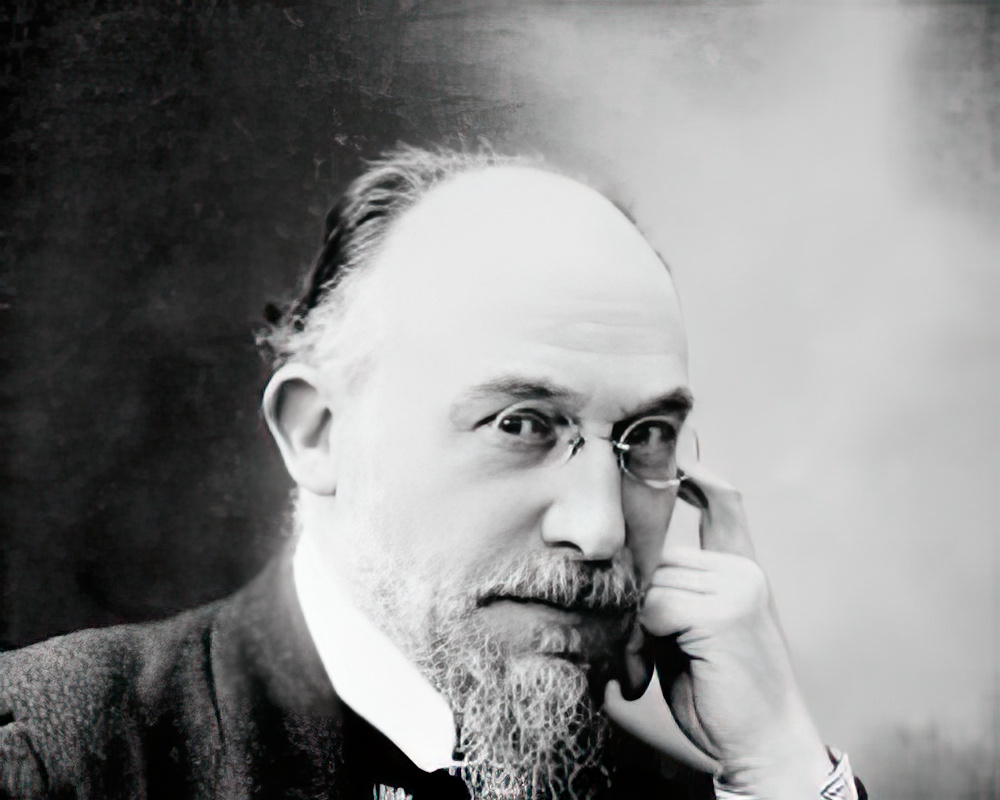
There is an anecdote that perfectly captures the peculiar essence of Erik Satie. For a decade, from 1898 until 1908, Satie was known as "The Velvet Gentleman." He lived in a tiny room in Arcueil, a working-class suburb of Paris, which he called his "cupboard." During this period, he purchased seven identical, gray-corduroy velvet suits. He wore one every single day. His contemporaries saw it as another of his bizarre affectations, a deliberate performance of eccentricity. Yet, behind this velvet facade was a man of profound artistic integrity, a composer whose quiet rebellion against the grandiose sentiments of Romanticism would send ripples through the entire landscape of 20th-century music. He was a minimalist before minimalism existed, an absurdist before the Dadaists, and a creator of ambient music long before the term was coined.
Early Life
Alfred Éric Leslie Satie was born on May 17, 1866, in Honfleur, Normandy. His early life was marked by displacement and loss. His father, Alfred Satie, was a shipbroker, and his mother, Jane Leslie Anton, was of Scottish descent. Following the Franco-Prussian War and the Paris Commune, the family moved to Paris in 1871. A year later, his mother died. Erik and his younger brother, Conrad, were sent back to Honfleur to live with their paternal grandparents. It was here that he received his first music lessons from a local organist. This idyllic period ended tragically in 1878 when his grandmother was found drowned on the beach. The boys returned to Paris to live with their father, who had since remarried a young piano teacher and salon composer, Eugénie Barnetsche.
His new stepmother recognized his musical talent and began preparing him for a formal education. In 1879, Satie was enrolled in the Paris Conservatoire. It was an unmitigated disaster. His professors found him listless, uninspired, and untalented. His piano teacher, Émile Descombes, described his playing as "insignificant and laborious," while his composition instructor, Georges Mathias, labeled him "the laziest student in the Conservatoire." Satie, for his part, found the institution's rigid academicism profoundly suffocating. He was dismissed after two and a half years, only to be readmitted in late 1885 after a brief and equally unhappy stint in the military. His second attempt was no more successful, and he left the Conservatoire for good in 1886, convinced that his artistic path lay far outside its hallowed halls.
The Montmartre Years
Satie found his true university in the bohemian streets, smoky cafés, and vibrant cabarets of Montmartre. He took a room at the Auberge du Clou and began working as a pianist at the famous Le Chat Noir cabaret. It was here that he shed his provincial past and cultivated the persona of the witty, iconoclastic artist. He befriended many key figures of the Parisian avant-garde, including the poet Stéphane Mallarmé and, most significantly, a young Claude Debussy. Their friendship was deep and mutually influential; Satie's harmonic innovations piqued Debussy's interest, while Debussy’s professional success often provided Satie with much-needed financial support. It was Debussy who would later orchestrate two of Satie’s Gymnopédies, bringing his friend’s work to a much wider audience.
This period was also marked by a fascination with mysticism and esoteric religion. Satie became the official composer for the Rosicrucian sect, a mystical order led by the flamboyant writer Joséphin Péladan. For Péladan's Salon de la Rose + Croix, he composed several pieces, including the Sonneries de la Rose + Croix. This mystical inclination eventually led him to found his own mock-religion in 1893, the Église Métropolitaine d'Art de Jésus Conducteur (Metropolitan Church of Art of Jesus the Conductor), of which he was the sole member, serving as "Parcier et Maître de Chapelle" (Abbot and Choirmaster). He published his own journal, Le Cœur, to attack his critics and expound upon his artistic and religious doctrines.
Amidst these eccentric activities, Satie composed the works that would become his most famous. In 1888, he published the Trois Gymnopédies, three serene and melancholic piano pieces whose spare texture, free-flowing rhythm, and hauntingly simple harmonies were a radical departure from the virtuosic bombast of late-Romanticism. They were followed by the equally innovative Gnossiennes (1890), which were notable for being composed without bar lines or time signatures, giving the performer great rhythmic freedom. It was also during his Montmartre years that Satie had his only known romantic relationship, a passionate but short-lived affair with the painter and artist's model Suzanne Valadon. The affair ended after six months, leaving Satie, by his own account, with "nothing but an icy loneliness that fills the head with emptiness and the heart with sadness."
The Arcueil Sage
By 1898, burdened by debt and disillusioned with the bohemian lifestyle, Satie made a drastic change. He moved to Arcueil, a distant, industrial suburb of Paris, where he would live in spartan seclusion for the rest of his life. For years, none of his friends from Paris ever visited his humble apartment; they only knew he made the long walk into the city center each day. It was during this period that he adopted his uniform of gray velvet suits.
In a move that stunned the Parisian music world, at the age of 40, Satie enrolled as a student at the Schola Cantorum de Paris in 1905. He wanted to master the academic techniques he had once scorned. He studied counterpoint under Vincent d'Indy and Albert Roussel, two highly respected but conservative figures. Satie proved to be a brilliant and dedicated student, earning a diploma avec la mention "très bien" (with the mention "very good") in 1908. This formal training gave him a new compositional discipline, which he integrated with his inherently unconventional style. He began writing with greater confidence and structure, though he never lost his trademark wit, often embedding bizarre, narrative instructions into his scores, such as "with great astonishment" or "like a nightingale with a toothache."
Musical Style and Innovations
The final phase of Satie’s career saw him embraced by a new generation of avant-garde artists. He became a spiritual guide for a group of young composers who came to be known as Les Six, which included Francis Poulenc and Darius Milhaud. They admired his anti-Wagnerian, anti-Impressionist stance and his distinctly French clarity and wit.
His most famous collaboration was with the writer Jean Cocteau and the artist Pablo Picasso on the 1917 ballet Parade. Produced by Sergei Diaghilev's Ballets Russes, the work was a revolutionary "realist ballet" that depicted scenes from a Parisian street fair. Picasso designed the radical cubist sets and costumes, and Satie's score incorporated non-musical sounds like a typewriter, a foghorn, and a pistol. The premiere was a scandal, causing a riot in the audience and cementing Satie's reputation as a leader of the musical avant-garde. The work deeply influenced other composers, including Igor Stravinsky.
Satie's innovations were legion. He explored musical repetition to an extreme degree in his 1893 piece Vexations, a short, dissonant theme with instructions that it be repeated 840 times. While likely a conceptual joke, it was later hailed by John Cage as a precursor to minimalist and process music. Perhaps his most forward-thinking concept was musique d'ameublement or "furniture music." Composed in 1920, it was music designed not to be listened to, but to be a part of the ambient background, mingling with the sounds of conversation and clinking knives and forks. At its premiere, Satie was horrified when the audience fell silent to listen, and he had to run around the room imploring them to "Talk! Talk! Keep talking!" It was a prophetic vision of what would one day be called ambient music.
Legacy
Erik Satie died on July 1, 1925, from cirrhosis of the liver. After his death, his friends finally entered his squalid apartment in Arcueil. They were shocked by what they found: alongside mountains of unsorted papers and two grand pianos stacked one on top of the other, they discovered his collection of identical velvet suits. He was a man of profound contradictions: a serious student of medieval music who worked as a cabaret pianist; a reclusive sage who collaborated on a scandalous public ballet; a composer of achingly beautiful melodies who also created deliberately boring "furniture music."
For many years, Satie was dismissed as a mere eccentric, a minor composer of charming but slight piano pieces. However, his true influence grew quietly over decades. Composers like John Cage, Virgil Thomson, and the minimalists of the 1960s saw in Satie a visionary who liberated music from the tyranny of expression and formal development. Today, he is recognized as a pivotal figure who challenged the very definition of what music could be. The serene, introspective beauty of his Gymnopédies and Gnossiennes has made them some of the most recognizable and beloved pieces in the classical repertoire, ensuring that the strange and wonderful music of the "Velvet Gentleman" continues to enchant listeners around the world.
Davis, Mary E. Erik Satie. Reaktion Books, 2007.
Gillmor, Alan M. Erik Satie. Twayne Publishers, 1988.
Harding, James. Erik Satie. Praeger Publishers, 1975.
Orledge, Robert. Satie the Composer. Cambridge University Press, 1990.
Volta, Ornella. Satie Seen Through His Letters. Marion Boyars, 1989.

Follow us : 


Sheet Music International - Copyright 2025 all rights reserved
| English: Sheet Music (PDF) | Free Scores | Français: Partitions (PDF) | Musique gratuite | Ελληνικά: Παρτιτούρες (PDF) | Δωρεάν μουσική |
| Deutsch: Noten (PDF) | Kostenlose Partituren | Español: Partituras (PDF) | Música impresa | Português: Partituras (PDF) | Música gratuita |
| Italiano: Spartiti (PDF) | Partiture musicali | Русский: Ноты (PDF) | Бесплатные партитуры | Norsk: Noter (PDF) | Gratis noter |
| Українська: Ноти (PDF) | Безкоштовні партитури | Polski: Nuty (PDF) | Darmowe nuty | Nederlands: Bladmuziek (PDF) | Gratis partituren |